
Trump in Beijing's Springtime?
China hardly has to do anything to influence the public diplomacy visuals if Trump goes to Beijing. Trump and his team of short-horizon oil market traders are way outta their league.

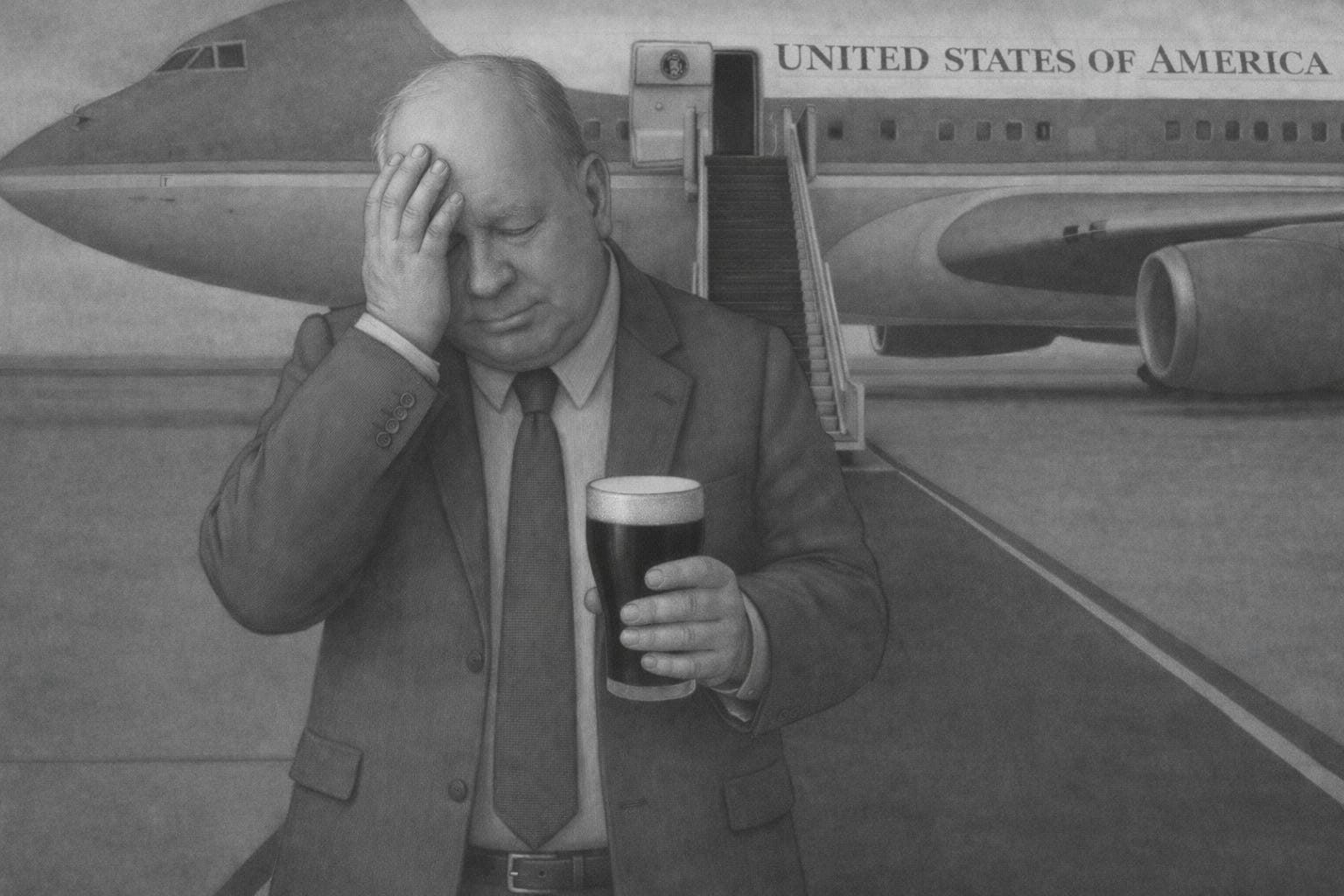
Trump is scheduled to visit Beijing May 14–16. The public diplomacy imagery, if he goes to Beijing, will define the era.
If you thought the repetitive foreign policy failures, from tariffs and Greenland to Iran and NATO; the rambling late night social media posts; and the confused, nonsensical address to the nation were signs of American decline, just wait till Beijing. It is from this visit that future textbooks will take their imagery.
Think about it for a moment - a confused, physically weak, tired old Trump, meets a firm-standing and focused Xi. We’ll see Trump and his team of real-estate financiers: instigators of wars of aggression and de facto war criminals; floundering engineers of global economic collapse; and desperate supplicants ready to perform tributary rites.
The visit was originally scheduled earlier, but put off, either because Trump imagined things would be better by mid-May or because Xi didn’t want to be seen next to Trump as he launched a war of aggression. That delay lends the trip a different tone.
America’s fortunes since the the attack on Iran have tumbled - economic strain, geopolitical overreach, and domestic political fragility. Trump’s approval ratings hit new lows every day; he has lost his base and now relies on shills like Mark Levin to push Israel’s wars to pensioners between ads for gold and weight loss drugs; and his party is looking down the barrel of its worst midterms ever. Trump is toast.
China, like any state, carefully manages its public diplomacy imagery. The first image will be arrival. Trump descending the aircraft stairs onto Chinese soil will not evoke the assured theatre of past presidential visits. There will be no sense of commanding presence or agenda-setting authority - despite Trump’s always hollow pomposity. Instead, the visual grammar will suggest concession: a leader arriving late, under pressure, and on terms increasingly set by the host. The symbolism will be subtle but unmistakable—this is not 1972, and Trump is not Nixon.
The second image will be the greeting. Xi’s composure—carefully cultivated, immovable—will contrast sharply with Trump’s performative unpredictability. In earlier eras, American presidents set the tone of bilateral encounters, their presence shaping the rhythm and staging of diplomacy. In Beijing, the choreography will belong to China. The setting, the pacing, the framing: all will reinforce hierarchy without ever stating it. Xi will appear as the steady axis of a system; Trump as the visitor seeking accommodation within it.
Then come the meeting room visuals—the long tables, the symmetrical delegations, the flags placed with geometric precision. Here, the contrast will deepen. Xi will project continuity: a leader presiding over a state that has prepared for this moment over decades. Trump, by contrast, will carry the weight of immediate crises. A financial system shaken by instability, alliances frayed by unilateralism, and conflicts either escalated recklessly or left unresolved. Whether framed as the brandisher of overwhelming force or as a leader mired in strategic overextension, the visual impression converges: a presidency defined by disruption now seeking stabilisation from abroad.
Yet, China hardly has to do anything to influence the public diplomacy visuals on this occasion. Trump and his team of short-horizon oil market traders are way outta their league.
Anyone paying attention knows this. A hollowed out State Department led by Rubio, but negotiations led by Kushner and Witkoff versus Russians backed by the institutional knowledge of the Russian Diplomatic Academy and its Foreign Ministry full of skilled, experienced diplomats? A hollowed out State Department led by Rubio, but negotiations led by Kushner and Witkoff versus Iranians with combat experience, PhDs, and years of diplomatic experience? Now, a hollowed out State Department led by Rubio, with negotiations led by Trump? The visuals coming out of this trip will seal regional views of the post-American order.
Trump’s visit will not be remembered for any specific agreement—trade concessions, security assurances, or diplomatic frameworks. It will be remembered as a visual marker of transition. A moment when the imbalance between image and reality collapsed, and the United States could no longer sustain the performance of primacy.
There are, of course, multiple possible interpretations. American officials will frame the visit as pragmatic engagement, a necessary dialogue between great powers in a complex world. They will emphasise negotiation, mutual interest, and strategic competition managed responsibly. Why Mark Levin will even sell it as a huge success. But such language operates at the level of text. The images will operate at the level of perception—and perception, once fixed, is far harder to revise.
For international audiences, particularly in Asia, the message will be clear. The visit will signal that even at its most assertive, Washington must ultimately turn to Beijing. That economic stability, conflict management, and geopolitical equilibrium increasingly run through China. That the gravitational centre of the system has shifted.
In this sense, the visit will not mark a dramatic collapse but something more consequential: recognition. Empires rarely end with formal declarations. They fade through moments of adjustment—through visits that would once have been unnecessary, through gestures that would once have been unthinkable. The language remains the same; the meaning changes.
What will be captured in May is precisely such a moment. A U.S. president, weakened by crisis and constrained by circumstance, standing alongside a Chinese leader whose system has absorbed shocks and extended influence. The images will not declare the end of American power. They will not need to. They will show a world already behaving as if that end has, in practice, arrived.
And that is how it will enter future textbooks if Trump goes to Beijing.
A very intriguing essay.
Thank you.