
The zombie middle powers
Albanese and Carney’s jump between support for the U.S. and middle power camaraderie showed that middle powers can be both dead and alive.

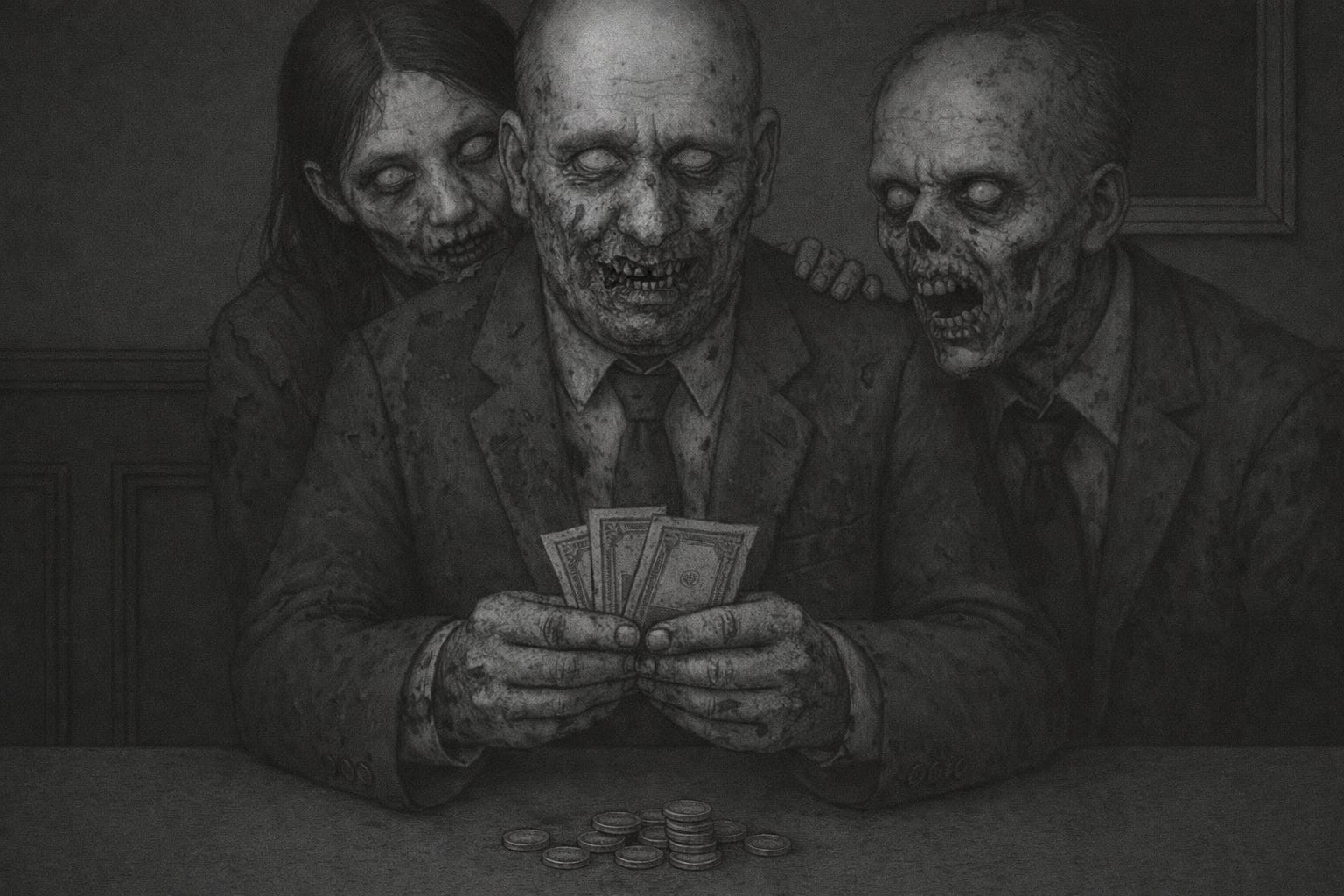
The era of middle power zombies is upon us. Reactions to the U.S.–Israeli strikes on Iran exposed the zombie logic of middle-power diplomacy. Albanese and Carney’s jump between support for the U.S. and middle power camaraderie showed that middle powers could be both dead and alive. Meanwhile, Copenhagen defended American security concerns abroad at the United Nations Security Council (UNSC) with Greenland still in Washington’s sights. Denmark’s performance was a cannibalistic zombie horror flick.
How did we get here? When did the zombie apocalypse occur? What can we do?
Middle powers were not always like this. We know this because every now and again, the giants of Australian foreign policy remind us of the successful middle power initiatives under their watch, and assure us that we can do it again.
Unfortunately, they rarely acknowledge that those successes were products of a very specific historical moment that no longer exists. In theory and policy, the middle power has long been the living dead.
Dead or alive? Theory or practice?
As anyone in the field knows, internationals relations theory doesn’t live up to the standards of the fields from which it borrows, and isn’t accepted by the practitioners for who it’s written. The gap between middle power theory and practice is wide.
The struggle for middle power theory began with an effort to translate what was a convenient rhetorical device used by politicians and diplomats to secure influence in post-World War II governance structures into the then relatively young discipline of international relations.
In the social sciences, theory consists of assumptions, concepts, relationships, and units of analysis. Middle power scholars never moved beyond the conceptual definition. States were classified by hierarchical position, material capacity, diplomatic behaviour, or self-claimed identity, producing an ever-expanding catalogue of definitions. The literature repeatedly refined or reinvented the concept rather than building cumulative theory, leaving the field rich in definitional debate but poor in explanatory power.
Nothing constrained politicians and diplomats using the term as a rhetorical tool to inspire domestic support for foreign policy, build international coalitions, and promote status. Australia and Canada in the 1990s, South Korea in the 2010s, and more recently Kazakhstan in the 2020s, all deployed the language of middle power diplomacy to promote external policies to domestic and international audiences. Each of these countries have wielded the term to promote anything and everything - a convenient rhetorical device.
Political rhetoric is powerful and sooner or later influences theory. The political economy of academia steers research agendas toward funding and institutional priorities, particularly in states promoting a middle-power identity, leading scholarship to reproduce policy narratives.
The sociology of academia suffers from generational institutionalization that encourages junior scholars to work with senior scholars on the same conceptual framework, and builds publishing circles that reward incremental refinements but discourages fundamental challenges. Meanwhile, the corporatization of academia encourages metrics that generate a morass of feckless studies, driven by a system that rewards publications over genuine scholarly contribution.
The end result - a zombie academic field to match the zombie political rhetoric. Rather than generating new explanations, the middle power literature increasingly resembles a degenerative research program sustained by conceptual stretching, disciplinary inertia, and reactive commentary on state behavior.
When zombies attack
If zombie movies tell us anything, it’s that there’s always a slim chance of redemption as the world is overrun by zombies. We don’t have to do anything.
What has collapsed is not the existence of states occupying the middle ranks of the international system but the intellectual framework used to describe them. The modern middle power literature was built for the liberal international order of the late twentieth century. That world is gone.
Albanese and Carney still speak the language of middle-power norms, but when confronted with the realities of bombed hospitals, destroyed schools, and unprovoked wars of aggression against sovereign states, both still fell neatly into Washington’s line.
The episode returned the concept to where it began: a convenient rhetorical tool.
The next era will likely be built around a different set of states—those more capable of adapting to a harsher and more transactional international order. South Korea? Singapore? Kazakhstan? Iran? States already adjusting to a changing system. The focus will shift to how states survive and thrive in a post-American order where power is more widely dispersed.
In such a world, the language of middle powers will likely reflect a broader range of non-Western political traditions and strategic cultures rather than the liberal institutional ideals that shaped the concept in the late twentieth century. The academic discourse that tied the study of middle powers to these increasingly zombie-like political narratives will fade.
Daniel Drezner gave students an edge by exploring international relations theories through the thought experiment of a zombie apocalypse, but nobody thought that zombie apocalypse would start with the middle powers.
Unprovoked wars of aggression? Oh that's some bullshit rhetoric.
https://www.instagram.com/reel/DV-3HYKDXnS/?igsh=MW10ZGV2aGFidGp6dw==