
A banana republic with nuclear subs
Australia getting nuclear subs is like a medieval knight putting on armor to fight diarrhea—externally an elaborate defense, internally, just a pile of shit.


Twenty years from now Australia will have gotten over the nuclear subs problem. It’ll have a complete complement of strike aircraft, advanced drones, long-range precision strike missiles, and maybe even nuclear subs. Sadly though, it’ll be like a medieval knight putting on armor to fight diarrhea—externally an elaborate defense, internally, just a pile of shit.
It makes you wonder, what are they thinking? With their heads in the Canberra bubble (or up somewhere much darker) debating deterrence, gray zones, and China threats, Australia’s defense planners, strategists, and foreign policy folk have missed the broader picture.
As they spend more and more tax money on subs instead of housing, education, healthcare, aged-care, infrastructure, employment, law and order, public transport, and regional development, there’s three things to think about.
First, Gen-Z won’t fight. There’s a simple truth: people will only fight for a country when it belongs to them. The point is not military but social. Citizens who have a stake in their society—secure jobs, affordable housing, functioning public institutions, and confidence that the system treats them fairly—will defend it. Conversely, if they’ve been priced out of home ownership, burdened with insecure work, and left with declining public services, appeals to patriotism ring hollow.
This is the uncomfortable question Australia should be asking about Gen-Z. It is not whether they are brave enough to fight, but whether they feel they have enough worth defending—no jobs, f@cked public transport, rental queues around the block, machete gang wars in the suburbs, and no chance of ever owning a house. As Singapore’s leaders repeatedly argued, national defence ultimately rests not on weapons or military spending, but on citizens believing the nation is theirs and that its future is worth sacrificing for. Somehow Australia’s leaders have forgotten that.
Second, Australia’s politicians are seeking to defend a country that has already disappeared. Australia in twenty years more will not be the Australia imagined by today’s strategic class. The America-focused baby boomers who grew up during the Cold War will have largely left public life, replaced by younger Australians who have no memory of the Soviet Union, ANZUS triumphalism, or Washington as the unquestioned center of the world. Boomers grew up with Captain Cook, ANZACs, and Ned Kelly nationalism. Gen-Z has grown up with division, self-hatred, and displacement.
At the same time, immigration has reshaped the country’s demographics, making Australia more Asian, more globally connected, and less emotionally invested in the geopolitical assumptions of previous generations. For many of these Australians, China will not simply be a military problem discussed in think-tank reports. It will also be a place of business, opportunity, family, tourism, education and culture. Beijing will be a place in the Australian imagination similar to that once held by New York or London: a distant global metropolis where ambitious young people go to build careers.
Even Australia’s strategic studies, defense and foreign policy folk will change. The next generation of analysts will not have grown up on Fulbright fellowships, Washington internships, ANU national security seminars and think-tank trips to DC. Increasingly, funding and fellowship opportunities, networking opportunities, and young leaders networks will be in Beijing, Shanghai or Shenzhen. The better paying jobs, the better study opportunities, and the better conferences will be in China. Narratives built around the permanent, all-consuming “China threat” will no longer resonate.
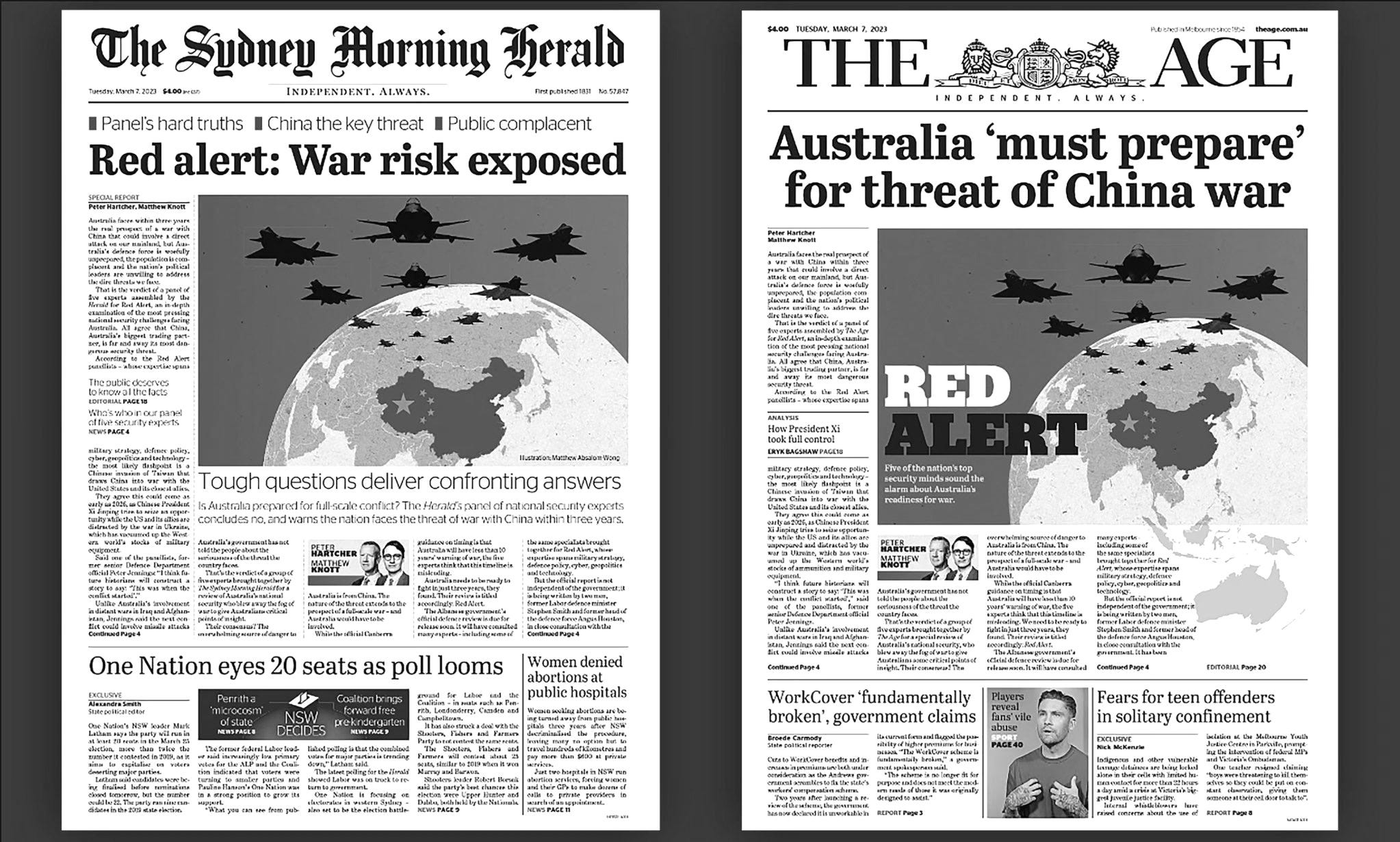
Finally, China won’t invade. China is not going to invade Australia because it does not need to. Why send soldiers when Australia already ships out its iron ore, coal, gas and other raw materials at bargain rates, then politely fails to tax the profits properly? Invasion is expensive, risky and politically disastrous. Buying the place’s dirt and gas under friendly commercial terms is cleaner, cheaper and already working. The only real risk, is Australia being dragged into a conflict it didn’t want. For Beijing, Australia is less a fortress to storm than a feckless poorly managed quarry to buy and improve—and one that will be less and less relevant as time goes on.
Australia’s housing, education, healthcare, aged-care, infrastructure, employment, law and order, public transport, and regional development are broken. Australia will eventually get its submarines—but without fixing what’s broken, it’ll be a proud shiny medieval knight with a foul case of diarrhea. A banana republic with nuclear subs.
—
Support this blog. Don’t just recommend it - Buy Me a Coffee!