

These twelve posts run you through the writing of an IR academic paper. You can think of it as an IR Research Methods course. The series of articles run through the planning, development, and completion of a guided research paper in the field of in international relations (or international studies or diplomatic studies).
I’ll use the term International Relations (IR), because I’m old and set in my ways and hang on the idea that I’m an IR academic and so everything I do is IR. It’s self-centered and definitely not academic. So when I say “IR”, I’m really covering the broad gamut of disciplines that involves more than one country, so I’d probably be better using the term International Studies (IS). In the end, what you call it less important than what actually do.
I’m giving you the ins and outs, down to earth, reality of academic research in IR. I’m taking you through the writing of an IR academic paper in a step-by-step process. Hopefully, it will help some budding academic out there somewhere.
Rather than studying research methods in isolation, you’ll learn research design by applying each stage of the process to your own project--so before you read more, start thinking about what you want to research!
Course introduction
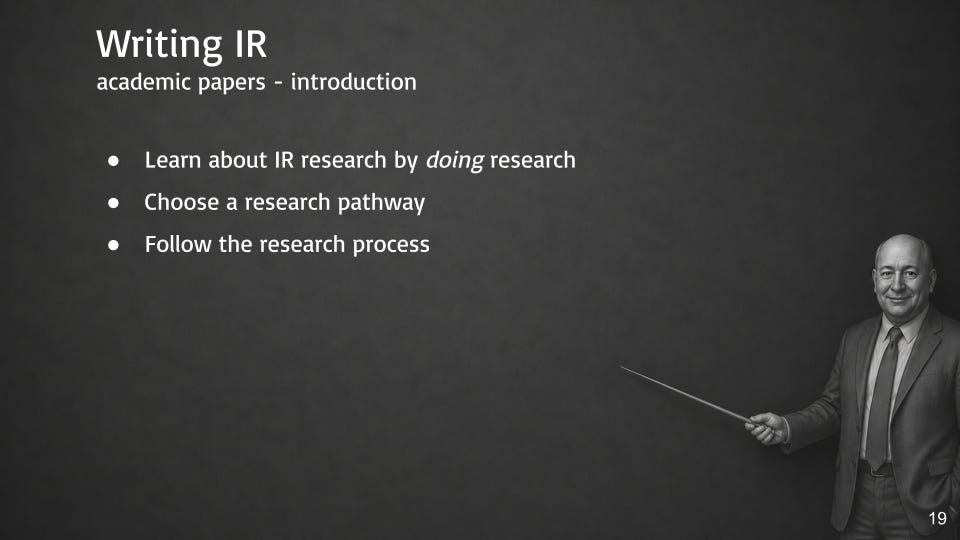
Learn research by doing research — Plan, develop, and complete a guided academic research paper in international relations.
Choose a research pathway — Study the discipline, the individual, or the nation, while developing your own research question and analysing evidence.
Follow the complete research process — Move from ethics, literature, theory, and research questions through research design, methods, data collection, analysis, and the final paper.
You can choose one of three guided research pathways focusing on either (a) the discipline, (b) the individual, or (c) the nation. Each has a common structure but allows you to develop your own research questions, collect and analyse evidence, and draw independent conclusions.
The course follows the research process from beginning to end. It begins with research ethics, academic practice, reading scholarly literature and preparing a literature review. You then cover the role of philosophy and theory, learn how to formulate research questions and hypotheses, and develop a research proposal.
The second half of the course covers research design and the collection and analysis of evidence. You’re introduced to exploratory, descriptive, and explanatory research; quantitative, qualitative, and mixed-method approaches; sampling strategies; and methods of data collection including documentary research, observation, surveys, and interviews. The course finishes up with an introduction to quantitative and qualitative data analysis.
By the end of the course (or reading of the twelve pieces), you’ll have experienced the major stages of the research process and have completed an academic research paper that demonstrates the ability to formulate a researchable question, engage with relevant literature and theory, select appropriate methods, collect and analyse evidence, and present a clear and supported argument.
The guided academic paper
As noted, this research design course explores the basics of research through the planning, structuring, researching and writing of a guided academic paper in the field of international relations. You can choose between a guided research plan focusing on (a) the discipline; (b) the individual; or (c) the nation.
The discipline
Research doesn’t always have to be about states, people, wars, diplomacy, or international events. Sometimes, we can turn the research process back on itself and study how academics actually do research. That’s what this type of academic paper is all about.
The discipline
Focus on research itself — Examine how international relations has been studied and how the discipline has developed.
Treat academic literature as data — Analyse published research according to topics, theories, methods, geographical focus, or other characteristics.
Identify trends in the field — Examine patterns and changes over time to understand how IR research has developed.
Think about International Relations (IR) as an academic discipline. Thousands of articles are published every year, but what are scholars actually researching? What theories are they using? What methods do they prefer? Which countries and regions get the most attention—and which are largely ignored? Are there hidden agendas in writing about certain subjects? Is academia just a more highfalutin form of the mainstream media? Do these patterns change over time? These are all questions we can answer by treating published academic research as our data.
An example of this type of paper is Maliniak, Oakes, Peterson, and Tierney’s article, “International Relations in the US Academy” (International Studies Quarterly, 55-2, 2011). It’s a great read. They examined articles published in twelve leading IR journals, alongside surveys of American IR scholars. They classified the research according to things such as theory, methodology, and epistemology. This showed trends in the discipline, including growing theoretical diversity, the increased use of quantitative methods, and the continued importance of positivist research.
Choose this pathway, and you’ll do something similar—but on a much more manageable scale. You might take ten years of articles from one journal and ask what subjects researchers have studied, which theories they’ve used, what methods they’ve chosen, or which countries and regions they’ve focused on. Or you might choose a particular area of research—middle powers, diplomacy, international organizations, articles on Korea, conflict, foreign policy, or something else that interests you—and examine how that research has developed.
Remember tho, you’re not simply reading articles and talking about what they say. The articles themselves are your data. You gotta choose a way to sample the articles, classify them, look for patterns, work out what those patterns mean, and use them to say something about how research is actually being done. In other words, you’re gonna do research on research.
Take ten minutes now. Go to Google Scholar, search for a subject you’re interested in and look at how many articles there were over the last ten years. Can you see anything that stands out? Now look over the period 11 to 20 years ago. Is there any difference? This quick ten minute perusal of titles was your first step.
The individual
The next type of paper is about what people think. Why do some people see China as a threat while others don’t? Why do some strongly support an alliance with the United States while others are much less enthusiastic? Why do people disagree about immigration, foreign aid, nuclear weapons, international organizations, or military intervention? That’s what this type of paper is about.
The individual
Focus on people — Examine what individuals think about international issues, countries, conflicts, or foreign policies.
Treat individual responses as data — Use surveys to collect information about attitudes alongside characteristics such as age, education, political orientation, experience, or personality.
Explain differences in attitudes — Identify patterns and relationships to understand why individuals hold different views about international affairs.
The basic idea is pretty simple: choose an international issue and find out what people think about it. Sounds easy - but it’s got to be both insightful and add to knowledge. You gotta go one step further and ask why people think differently. Their attitudes might be connected to their age, gender, education, political views, knowledge, personality, personal experiences, or perceptions of threat. Instead of states or academic articles being your main object of study, here you’re studying individuals—and what they tell you becomes your data.
A good example of this type of paper is Gravelle, Reifler, and Scotto’s article, “Personality Traits and Foreign Policy Attitudes: A Cross-National Exploratory Study” (Personality and Individual Differences, 153, 2020). They ask whether personality helps explain people’s foreign policy attitudes. Using surveys from six countries, they compare the Big Five personality traits with attitudes towards international cooperation, isolationism, military power, and global justice. What they find is that personality does seem to be connected to how people think about foreign policy, and many of these patterns appear across different countries.
Choose this type, and you’ll do something similar—but again, on a much smaller scale. You’ll choose an international issue, decide whose attitudes you want to study, and normally use a survey to collect your data. You might, for example, survey university students about their attitudes towards China and then see whether those attitudes differ according to political views, knowledge of China, previous travel, personal contact, or perceptions of China as a security threat.
The important thing is that you’re not just asking people what they think and reporting the results. You wanna find patterns and then try to understand them. Who thinks differently? What explains the differences? By collecting information about both your respondents and their opinions, you can start exploring why people see the world in different ways.
Take ten minutes now and ask the people around you their attitudes on the latest foolish war in West Asia or do a simple internet search for “attitudes”, “polls”, “support” and Iran. Of course, research on “what people think” does not necessarily have to includes surveys. You could also search for images of the near simultaneous national events of the funeral and the festival: in July 2026 millions turned out in Tehran to mourn its slain leader while in Washington only tens of thousands turned out to celebrate the 250th anniversary of American independence. As a reflection of support for the state at war, these images highlight attitudes. This quick ten minute search was your first step.
The nation
Finally, you can study International Relations by looking at what countries actually say and do. How does a country see the outside world? How does it talk about other countries? What does it say its interests are—and does this change when circumstances change? That’s what this type of article is about.
The nation
Focus on the state — Examine how a country understands, presents, or conducts its international relations.
Treat foreign policy activity as data — Analyse speeches, government documents, diplomatic statements, images, websites, social media, or events.
Identify patterns and change — Systematically examine the evidence to determine how a state’s foreign policy, relationships, or representations develop over time.
The basic idea is to choose a country and examine some part of its foreign policy using evidence that the country itself produces. That might mean speeches, government documents, diplomatic statements, press releases, websites, official images, social media, or records of particular events. You can then look for patterns in how the country talks about other countries, presents its interests, responds to international developments, or communicates its foreign policy.
In this type of paper, the nation is your object of study, while what it says and does provides your evidence. The aim is to use that evidence to understand how a country sees the international world and how it chooses to act within it.
A good example is my awesome article, “More than Old Friends? Narrative in Australia’s Relationship with Korea” (Australian Journal of Politics and History, 63-1, 2017). It examined how the Australian government presented its relationship with South Korea through official foreign policy communication. It identified three recurring stories concerning early Australian missionaries in Korea, Australia’s contribution to the Korean War, and Australia’s role in Korea’s economic development. It then used rhetorical analysis to examine how they appeared across different levels of official communication, including foreign policy white papers, ministerial speeches, parliamentary submissions, and government websites. The study showed how these sources can reveal the way nations shape their relationships with other states.
Choosing this guided paper, and you’ll do something similar—but on a much smaller scale. You’ll choose a country, decide what part of its international relations interests you, and then work out what evidence you can use to investigate it. You might look at ten years of presidential speeches to see how South Korea talks about China, compare government statements before and after an important international event, or examine how another country is portrayed in official images or social media.
The important thing is that you’re not just describing a country’s foreign policy. You’re looking at actual evidence, finding patterns and changes, and thinking about what they tell you. In other words, you’re using what a country says and does to better understand how it sees and deals with the international world.
Take ten minutes now to read the State of the Union address of the U.S. from the current year and from ten years ago. What has changed in sentiment of the two speeches? Does the change in sentiment justify looking further into a specific aspect? Could that change in sentiment be reflected in other state documents? This quick ten minute read of two speeches was your first step.
Success in academic research
By the end of this course, you’ll hopefully have a pretty good idea of how academic research actually works: how to develop a researchable question, work with literature and theory, choose your methods, collect and analyse evidence, and eventually turn all of that into an argument. These things matter, and you need to know how to do them. But they’re still just tools.
Knowing all the rules, though, doesn’t automatically mean you’ll produce interesting research. Academics produce an enormous amount of research--and there’s a lot of cr@p out there. There’s more journals, more articles, more reports, and more pressure to publish than ever before.
A lot of that research is perfectly competent. It follows the rules, uses the right methods, speaks the right academic language—and is quickly forgotten. Like who reads half of this boring sh!t?
If the only reason for doing a piece of research is that you’ve found a tiny “gap” nobody has filled yet, you might end up with something technically correct but not particularly interesting or important.
In my opinion, being a good researcher involves more than knowing the methods. You gotta produce something that people will actually read. You need creativity!
You need to be able to look at familiar problems in a different way, make connections that other people haven’t noticed, ask questions that haven’t been asked, and explain your ideas in a way that people actually want to read. Good research needs creative insight and good writing just as much as it needs methodological competence.
Lastly, research can be h@ll boring if you’re just going through the motions. Start the course not caring about the subject you’re researching, and by the end of the course, you’ll absolutely hate it! Research needs passion!
The best research usually starts with something you genuinely care about. Something that puzzles you, annoys you, surprises you, or simply makes you want to know more. Methods can be taught. Creativity can be encouraged. But passion is what keeps you going. From my experience, it’s also what makes the research more engaging for readers and audiences when you present.
Take ten minutes now to actually write down what you’re passionate about. There’s a real psychological and even physical process in moving information out of your head and either writing it down by hand or typing it out on a document. The idea that you’re passionate about something firms up and the neurons start firing and reaching new pathways out to the distant corners of your brain. Knowing what your passionate about is the first step towards completing an academic research paper.
Guided academic paper - starting a research diary
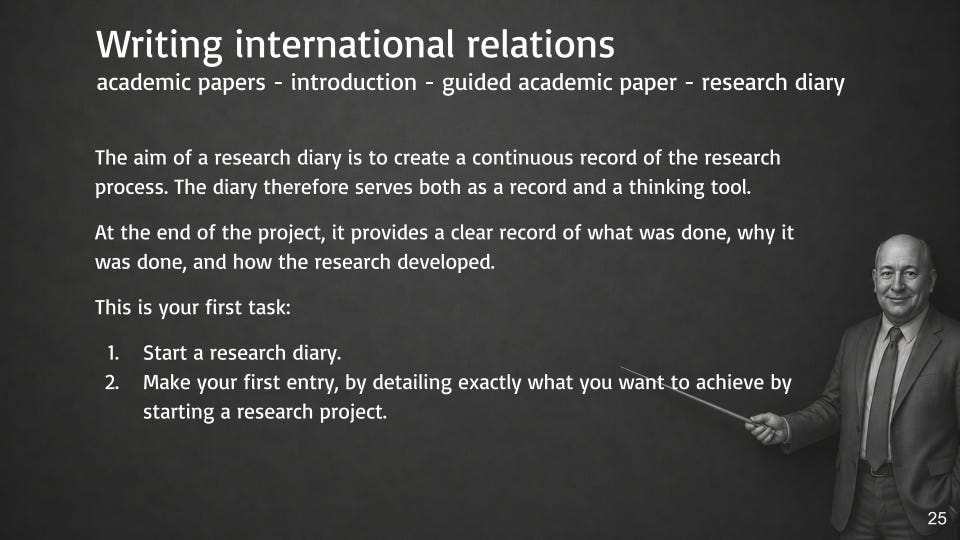
The aim of a research diary is to create a continuous record of the research process. It documents how the project develops from the initial idea through to the final analysis and writing. Researchers should record important decisions, changes in direction, problems encountered, methodological choices, observations, and reflections on what they are learning.
The diary therefore serves both as a record and a thinking tool. It helps researchers remember why decisions were made, reflect critically on their assumptions and possible biases, track the development of their ideas, and identify problems that may need to be addressed. By the end of the project, it provides a clear record of what was done, why it was done, and how the research developed.
Support an academic - Buy me a Coffee