

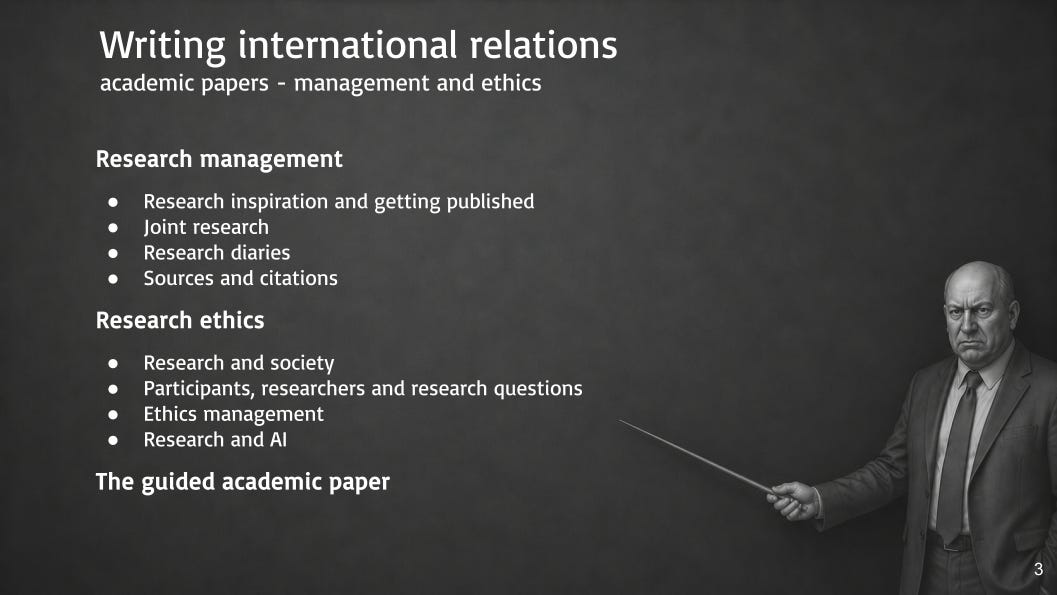
This second post in the series covers research management and ethics. It starts with a few basic pieces of advice on the practice of academic research--on research motivation; working with others; keeping a research diary; and managing sources and citations. It then looks at research ethics--including the rights of participants; the responsibilities of the researcher; the ethics of the research question itself; and the growing challenges raised by the use of AI in research. Finally, it applies these issues to the guided academic paper, and encourages you to begin thinking about possible ethical problems as you develop research ideas.
Academic research
As noted, academic research usually begins with personal interest and inspiration. Researchers are drawn to questions because they find them interesting, important, puzzling, or frustrating. Ideas can emerge from something encountered in a class, a book or article, a current event, a conversation, or previous research. Personal experience can also generate valuable research questions. Reflecting this... think now about what you want to research!
Academic research inspiration
Start with personal interest — Good research often begins with something you find interesting, important, puzzling, or frustrating.
Look for questions everywhere — Ideas can emerge from reading, teaching, current events, conversations, personal experience, or previous research.
Follow your curiosity — Research takes time and persistence, so choose a question that you genuinely want to answer.
Personally, I take the “previous research” route--but with a twist. I like to go through really old papers on the same or similar subjects and see how people wrote about the topic in its earliest stages. Those old papers (anything before the 1970s) are a treat to read. They’re near conversational, easy to read, and in my opinion, much better written than much of the academic dribble of today. Looking back also gives you an idea of how the field has changed.
Research projects require considerable time and effort, so genuine curiosity and enthusiasm for a subject is important in sustaining a project from the initial idea through to completion.
Academic research is of course, also a professional activity so for most people, one of the main goals is to get published. Research that sits on your computer or disappears into a filing cabinet doesn’t do much to academic debate—trust me. I have hundreds of half-finished papers. Oh, it doesn’t do much for your career either ;)
This means you should start thinking about publication fairly early in the research process. Where could this research eventually go? Could it become a journal article, a book chapter, a conference paper, or some other kind of publication? Some people like to even format their paper in the same way as the journal they’re aiming for, just to get them in the mindset. So if there is a particular undergraduate or postgraduate journal you want to publish in, it may pay to look through the journal carefully, and even set your sights on it from an early stage.
Getting published
Research is meant to be shared — Publication allows your ideas and findings to contribute to academic debate.
Think about publication early — Consider the audience, journal, conference, or other outlet while developing the research.
Make research work harder — One project can produce several outputs, such as a conference paper, journal article, and public-facing piece.
Now, you don’t need to have all of this worked out from the beginning, but it’s worth keeping in the back of your mind as the project develops.
Publication is what gets your research out into the academic world. It allows other researchers to read it, scrutinize it, challenge it, cite it, and build on it. At the same time, publications help build your academic reputation and are an important part of professional development and career progression. That’s simply part of the reality of being an academic.
As a practical principle, researchers should try to ensure that every research project produces several forms of output. A useful goal is to publish or communicate the research in at least three places or formats. The same project might produce a conference presentation, an academic journal article, and a shorter public-facing article or commentary.
A larger project might also contribute to a book chapter, policy report, dataset, or subsequent research project. This does not mean publishing the same article three times. Rather, the underlying research can be adapted for different audiences and purposes, allowing the work to have a wider academic and public impact.
Working with others
Much academic research is also conducted with other researchers. Co-authorship can be particularly valuable for junior academics. Working with an experienced researcher provides opportunities to learn how research projects are designed, how data are collected and analysed, how academic papers are structured, and how the publication and peer-review process works.
Joint research
Combine skills and expertise — Co-authors can contribute different theoretical, methodological, regional, or technical strengths.
Learn through collaboration — Junior researchers can gain experience in research design, writing, peer review, and publication.
Manage collaboration carefully — Agree early on responsibilities, workload, authorship order, deadlines, and publication plans.
Collaborators can bring different theoretical, methodological, linguistic, or regional expertise to a project, while sharing the workload involved in collecting data and preparing a manuscript. Collaboration also helps junior researchers develop professional networks and can make ambitious projects possible that would be difficult to undertake alone.
Collaboration nevertheless has disadvantages. Junior researchers may perform a disproportionate amount of the work while receiving less recognition, and disagreements can arise over authorship order, intellectual ownership, workload, deadlines, or the direction of the research.
Working with established academics can also make it difficult for junior researchers to develop an independent research identity if most of their publications are co-authored. Expectations should therefore be discussed early: who will do what, who will be an author, how authorship order will be determined, and where the research will be published. Collaboration is an important part of academic life, but researchers also need projects that establish their own ideas, expertise, and scholarly identity.
It’s the same when working in groups in class. Every class group has that one free rider who does less work (that was probably me when at university). From teaching and observing student groups over a long time, I recognize that free riders are much less common than you’d believe. In fact, usually, it’s just a case of management. Find each person’s individual strengths and the group will work well. You gotta decide if you want to work together with others, or do the hard slog on your own.
In the end, your research should be organised so that another researcher—and your future self—can understand exactly what you did, why you did it, and where your evidence came from. This is where a research diary comes in handy.
Keeping a research diary
A research diary is a record of the research process. It documents what you have done, when you did it, and the decisions you made along the way. Entries might record literature searches, sources consulted, data collected, changes to the research question, problems encountered, discussions with a supervisor, or decisions about methods and analysis.
Keeping a research diary
Record what you do — Keep track of research activities, sources, data collection, and progress.
Record decisions and problems — Note changes to the research design, difficulties encountered, and why decisions were made.
Record ideas and reflections — Capture emerging patterns, possible explanations, questions, and next steps.
The diary does not need to contain polished writing. Its purpose is to create a continuing record of how the research developed from the initial idea to the completed paper.
A research diary is particularly important because research rarely proceeds exactly according to plan. Questions change, sources prove difficult to find, methods need adjustment, categories are added or removed, and unexpected findings suggest new directions. Recording these developments helps you remember what changed and why.
For example, if you decide to exclude a particular category of articles from a dataset, the diary should record when that decision was made and the reason for it. The diary therefore provides an audit trail that allows you to reconstruct and explain the decisions that shaped the final research.
The diary is also a place for reflection. Researchers should record emerging ideas, possible explanations, patterns in the evidence, doubts about their approach, and questions that need further investigation. These observations may later become important parts of the analysis or help explain methodological choices in the final paper.
A simple research diary does not need to be complicated: each entry can record the date, activity, observations, decisions, problems, and next steps. The most important requirement is to update it regularly rather than attempting to reconstruct the research process at the end.
Managing sources and citations
Good research requires a systematic way of collecting and organising sources. From the beginning of a project, researchers should keep a complete record of every book, article, report, website, dataset, or other source they might use. Sources can be organised into folders or collections corresponding to different topics or parts of the research project. Developing this system at the beginning is much easier than trying to reconstruct sources when writing the final paper.
Managing sources and citations
Record sources as you find them — Save complete reference details and always record page numbers while reading.
Keep sources organised — Connect notes, quotations, and evidence to their original sources and clearly distinguish them from your own ideas.
Use Zotero from the beginning — Store and organise sources, attach PDFs, take notes, insert citations, and automatically generate bibliographies.
Researchers should also record where information comes from while they are reading. Notes should always remain connected to the original source, and page numbers should be recorded for quotations, arguments, evidence, and other information that may later be cited.
Researchers must clearly distinguish between direct quotations, paraphrases of an author’s argument, and their own observations or ideas. Copying a passage into notes without recording its source or marking it as a quotation can easily lead to accidental plagiarism later. A useful rule is simple: whenever you record information that is not your own, record the source at the same time.
Zotero provides a simple way to manage this process. It allows researchers to collect bibliographic information directly from journal databases, library catalogues, and websites; attach and organise PDFs; add notes and tags; and arrange sources into collections for different projects or topics.
Zotero also integrates with word-processing software to insert citations and automatically generate bibliographies in the required citation style. However, Zotero is a research tool rather than a substitute for careful research practice. Researchers should check imported bibliographic information, correct errors, and ensure that page numbers and other citation details are accurate before submitting their work.
Personally, I write using Markdown, Zotero, and BibTeX. Markdown is a simple plain-text formatting system that allows you to structure your writing using basic symbols rather than menus or formatting tools. Zotero is used to collect and organise sources, while BibTeX stores the bibliographic information needed for citations and references. Together, they allow me to concentrate on writing while keeping formatting and referencing simple and largely separate from the text itself.
Research and society
Research ethics is always a reflection of society. What a society considers acceptable research depends on its wider ideas about individual rights, authority, scientific progress, and the responsibilities of researchers. Germany provides an important early example.
Research and society
Ethics reflects society — ideas about acceptable research change with social values and expectations.
Rules are not enough — Nazi medical experiments showed how ethical protections can collapse when wider social and political values change.
Universal standards — the Nuremberg Code (1947) established principles intended to protect participants and restore trust in scientific research.
In 1900, the Prussian government issued one of the earliest formal directives governing medical experiments on human beings, requiring consent for non-therapeutic research. Germany introduced further regulations in 1931 that established unusually detailed protections for research participants. In this sense, Germany was a leader in research ethics. Yet this did not last.
Under Nazi rule, doctors and scientists conducted experiments on concentration-camp prisoners and other vulnerable populations without consent and often with devastating or fatal consequences. These practices demonstrated how scientific institutions could abandon existing ethical standards when the values of the wider society change. Research could be scientifically organised and supported by respected institutions while still violating fundamental principles of human dignity.
After the Second World War, restoring confidence in science therefore required principles that went beyond the standards of any particular institution or state.
The 1947 Nuremberg Code, developed following the trial of Nazi doctors, attempted to establish universal principles for research involving human beings. Most importantly, it placed voluntary consent at the centre of ethical research and made researchers responsible for protecting participants from unnecessary harm.
The history of research ethics therefore reminds us that ethics is more than compliance with rules. It is an attempt to establish standards that allow society to trust researchers and the knowledge they produce.
If you’re a young researcher, think back to your days at school. Remember COVID-19. The period was the perfect example of (a) why many people distrust science; and (b) why it’s important that governments build up greater trust in science. Think about it, what could’ve been an emergency, a pandemic that could’ve wiped out millions, and we had very little faith in out government and their research bodies, and their ability to tell the truth. There are some basic reasons why trust broke down:
Pseudoscience
Junk science
Information overload
Misinformation
Disinformation
It’s interesting to note that modern research ethics were established in the late 1940s because it was believed that increasing faith in research and science would address concerns regarding a Western disadvantage vis-a-vis the Soviet Union in Cold War scientific competition. Perhaps it’s time to try again?
Modern research ethics standard developed around three concerns: the rights of participants, the responsibilities of the researcher, and the ethics of the research problem.
1. Ethics and participants
Research involving people creates particular ethical responsibilities. Participants give researchers access to their time, experiences, opinions, and sometimes highly personal information.
Integrity
Plagiarism
Credit
Conflicts of interest (including politics)
Social responsibility
Researchers must therefore protect participants from harm and respect their autonomy throughout the research process. This involves several basic principles, including voluntary participation, informed consent, anonymity, and confidentiality.
Voluntary participation. Participation in research should always be voluntary. People should be free to decide whether to participate and should be able to withdraw without penalty. Researchers must therefore avoid pressure, coercion, or situations in which participants feel they have no real choice.
Informed consent. Participants should understand what they are agreeing to before taking part. Researchers should explain the purpose of the research, what participation involves, any possible risks, and how the information will be used. Consent is meaningful only when participants have enough information to make an informed decision.
Anonymity. Anonymity means that a participant cannot be identified from the research data. Wherever possible, researchers should avoid collecting identifying information or remove it from their records. Researchers should also consider whether participants could be indirectly identified through details such as their occupation, location, or personal experiences.
Confidentiality. Confidentiality means protecting information that could identify participants. Researchers may know who participated, but they must control who has access to that information and how it is stored and reported. This may involve secure data storage, restricting access to research files, and removing identifying details from publications.
There are a number of well-recognized ethical lapses and amongst these, the Tuskegee Syphilis Study is one of the most famous. The Tuskegee Syphilis Study began in Alabama in 1932. It was run by the U.S. Public Health Service (USPHS) with the cooperation of the Tuskegee Institute and involved around 600 Black American men, most of whom were poor sharecroppers with little formal education and limited access to medical care.
About 400 had syphilis, while the remainder formed a control group. Researchers told participants that they had “bad blood,” a familiar local expression covering several illnesses, rather than clearly explaining their diagnosis or the purpose of the research. Many therefore believed they were receiving medical care rather than participating in a study of untreated syphilis. Even after penicillin became the standard treatment in the 1940s, effective treatment was withheld.
The study continued largely out of public view until Peter Buxtun, a Public Health Service employee, raised ethical concerns about it within the agency. After his objections failed to stop the study, he provided information to a journalist. In July 1972, Associated Press reporter Jean Heller broke the story nationally, revealing that the government had knowingly observed men with syphilis without providing them with appropriate treatment.
The resulting public outrage led to the study being terminated later that year and contributed to major reforms in the regulation and ethical review of research involving human participants.
Which principles were violated, and how? Participation was not genuinely voluntary because the men were misled about the nature of the study, and informed consent was impossible because they were not properly told their diagnosis or that researchers intended to observe untreated syphilis. Additionally, those who were illiterate and/or uneducated may have been unable to give consent.
Their anonymity was not protected because researchers knew and recorded their identities, while sensitive medical information was retained and shared. Most seriously, the researchers failed to protect participants from harm by withholding effective treatment even after penicillin became widely available.
Some people are more vulnerable in research because they may have less power, fewer choices, or a limited ability to understand or refuse participation. Researchers therefore have a particular responsibility to identify these groups and ensure that they are not exploited or placed at unnecessary risk. Which populations might be especially vulnerable in research?
As a researcher, you must think about whether such populations may be impacted by your research. The first step then, is to think about who is directly and indirectly impacted by your research.
2. Ethics and the researcher
Research ethics also concerns the behaviour and responsibilities of the researcher. Researchers are responsible for how research is conducted, how evidence is handled, and how findings are communicated. These responsibilities can be divided broadly into two areas: integrity in conducting research and ethical reporting of its results.
Reporting
Accuracy
Completeness
Positive and negative results
Openness and transparency
Dissemination
Integrity requires researchers to conduct their work honestly and responsibly. This includes avoiding plagiarism, giving appropriate credit to the work and contributions of others, and recognising the wider social consequences of research. Researchers must also identify and disclose conflicts of interest, including financial, professional, personal, or political interests that could influence their research or create the appearance of bias.
Reporting requires researchers to present their research accurately and completely. They should not fabricate, falsify, exaggerate, or selectively report evidence, and negative or unexpected findings should be treated as seriously as positive results. Researchers should be open and transparent about their methods and evidence so that others can evaluate their conclusions. They also have a responsibility to disseminate their findings so that research contributes to academic knowledge and, where appropriate, the wider community.
Students and junior researchers sometimes assume that good research must produce a positive result—that the original proposition or hypothesis needs to be proven correct. This is a misunderstanding of the purpose of research. A negative or unexpected result can contribute just as much to knowledge by showing that an assumed relationship does not exist or that an existing explanation needs reconsideration. Research is judged by the strength of its methods and its contribution to knowledge, not by whether its original expectations are confirmed.
3. Ethics and the research problem
Ethical questions begin with the choice of research problem itself. Researchers should consider why a particular question is worth studying, who might benefit from the research, and who might be harmed by it. A project can follow appropriate research procedures and still raise ethical concerns because of the question it asks or the assumptions on which it is based.
Researchers must also consider how the problem is framed. Research questions can reproduce stereotypes, stigmatise communities, or treat particular groups as problems to be explained. The language, categories, and comparisons used in research are therefore ethical choices as well as analytical ones. Researchers should think carefully about whose perspectives are included and whose may be overlooked.
At the same time, ethical concerns should not mean that difficult or controversial questions cannot be studied. Research often contributes most when it examines uncomfortable subjects or challenges accepted ideas. The responsibility of the researcher is to demonstrate that the question has scholarly value, consider its possible consequences, and design the research in a way that balances the pursuit of knowledge with responsibility to society.
Ensuring informed consent
Informed consent means more than simply asking a participant to sign a form. Participants must receive enough information to understand what the research is, what they will be asked to do, what risks are involved, and what will happen to their information. The information should be written in clear, accessible language and participants should have an opportunity to ask questions before agreeing.
An informed consent sheet should normally include:
Research purpose - what the study is about and why it is being conducted.
Researcher details - who is conducting the research and their institutional affiliation.
What participation involves - interviews, surveys, experiments, recordings, time required, etc.
Voluntary participation - a clear statement that participation is entirely voluntary.
Right to withdraw - when and how participants can withdraw, including any limits once data are anonymised.
Risks or discomfort - any reasonably foreseeable physical, psychological, social, professional, or other risks.
Potential benefits - what participants or society might gain, without exaggerating likely benefits.
Privacy and confidentiality - how identities and personal information will be protected.
Data collection and storage - what data will be collected, where it will be stored, who can access it, and how long it will be retained.
Use of data - how findings may be used in publications, presentations, teaching, or future research.
Recording and quotations - whether audio/video will be recorded and whether participants may be quoted.
Researcher contact details - how participants can ask questions about the study.
Ethics contact or complaints procedure - who participants can contact independently if they have concerns.
Statement of consent - confirmation that the participant has understood the information and freely agrees to participate.
The key principle is that consent must be informed, voluntary, and ongoing. A signed form documents consent, but it does not replace the researcher’s responsibility to ensure that participants actually understand what they have agreed to.
Think about the above informed consent list. Which points reflect the rights of participants, the responsibilities of the researcher, and the ethics of the research problem?
Research and AI
One of the largest emerging issues in research ethics is the use of artificial intelligence. AI can assist researchers with searching literature, analysing data, writing, translation, coding, and generating ideas, but it also raises fundamental questions about authorship, originality, accuracy, transparency, and responsibility. AI systems can produce convincing but false information, reproduce biases, and make it difficult to determine where the researcher’s own intellectual contribution begins and ends.
Research and AI
AI is here to stay and is useful if you use it effectively.
Follow ethical research guidelines and be transparent.
At all costs, avoid AI-generated rehash.
The ethical challenge is therefore not simply whether researchers should use AI, but how it can be used while preserving the integrity, transparency, and accountability of research.
My own view is that AI is here to stay. It will not disappear, and universities should not simply shun or forbid it. Instead, students and researchers need to develop the skills to use AI effectively and responsibly. No professor or editor wants to receive a veritable Sunday-morning spew of rehashed AI-generated text; it wastes the reader’s time and contributes little to knowledge.
However, using AI to analyse materials, compare large numbers of documents, identify patterns, or assist with other time-consuming research tasks can make research considerably more efficient. When researchers clearly explain where, why, and how AI was used, such use can represent both good research practice and ethical research. So, all up, using AI cos you’re lazy is a problem, using it as a tool is okay.
The guided academic paper - ethics
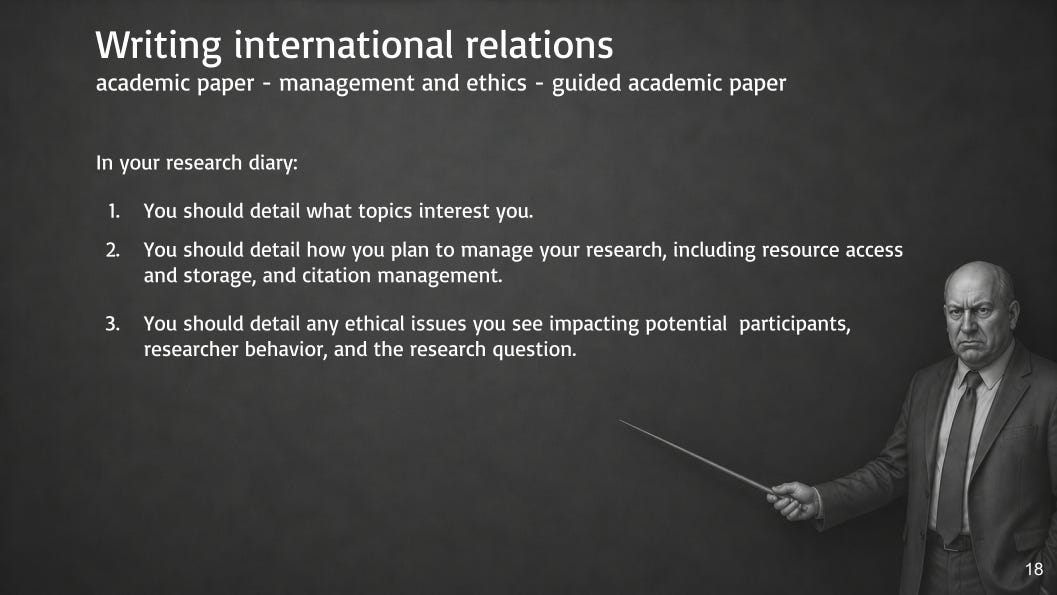
As noted, this course provides for guided research focused on (a) the discipline, (b) the individual, or (c) the nation. Your first task is to use your research diary to record the broad topics or questions that you might like to research.
Begin with something that you are passionate about: a country, issue, debate, behaviour, or pattern that you would like to understand better. At this stage, the idea does not need to be a precise research question. Look for things that seem interesting, surprising, different, changing, or difficult to explain. Write several possibilities in your research diary and briefly explain what interests you about each one.
You might notice a trend in academic research, differences in how people think about an international issue, or something unusual in the way a government conducts its foreign policy. Record these observations in your diary. They provide the starting points from which a more focused research question can later be developed.
You should also record an initial assessment of the possible ethical issues associated with your ideas. Consider the rights of respondents: could participants be vulnerable, could answering questions cause discomfort or risk, and can their privacy and anonymity be protected?
Next, record any ethical issues relating to your responsibilities as a researcher. Could your political views, personal experiences, or expectations introduce bias? How will you ensure that evidence is collected, stored, and represented fairly?
Finally, consider the ethics of the research question itself. Record whether your proposed research could make unfair assumptions about a nationality, gender, political group, or community; reinforce stereotypes; or cause unnecessary harm to those being studied.
Your research diary should therefore contain both your initial research ideas and your first assessment of their ethical implications. These entries do not need to be final. Return to them as your research question develops and record how your thinking changes.
Support an academic - Buy me a Coffee