

This third post in the series looks at reading and writing academic literature
Academic writing allows considerable freedom in principle, but in modern academia, and particularly in International Relations, articles tend to follow a relatively narrow range of formats. This contrasts with disciplines where the form of scholarly communication can vary substantially according to method or subject.
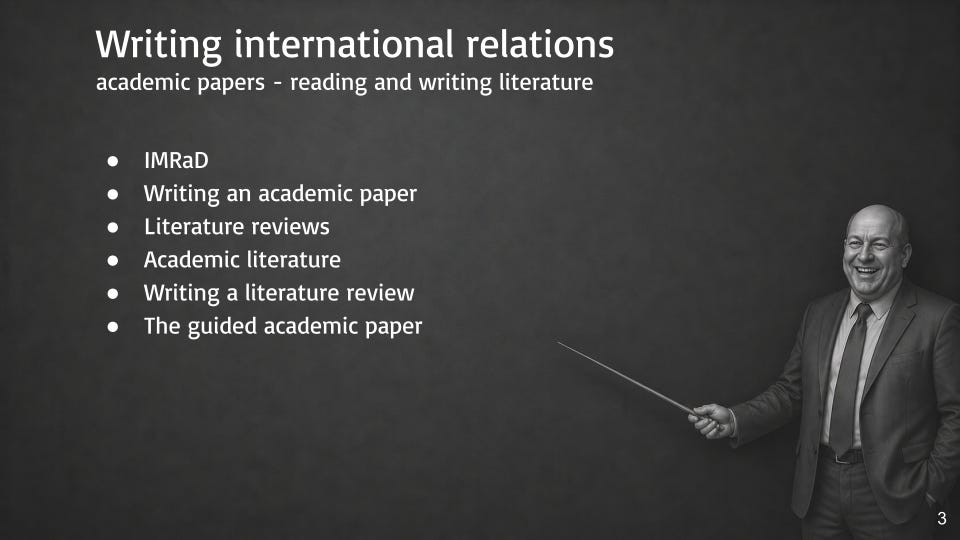
Writing and reading literature
IMRaD
Writing an academic paper
Literature reviews
Academic literature
Writing a literature review
The guided academic paper
Historical research may develop an argument through narrative, philosophy through sustained conceptual reasoning, and some humanities disciplines through interpretive essays. IR has increasingly converged around the journal article as its principal form of scholarly communication. Articles generally introduce a problem, position it within existing literature, explain how it will be investigated, present evidence or analysis, and conclude by stating what has been learned.
Yup, it’s pretty f&@king boring. The terminology and order vary, but the underlying structure remains mind-numbingly consistent. The simplest way to understand this structure is through IMRaD.
The IMRaD structure
IMRaD - Introduction, Methods, Results, and Discussion. Developed primarily in the natural and medical sciences, IMRaD provides a basic model for organising research around a sequence of questions.
The IMRad Structure
Introduction - defines the problem, significance, literature, and research question.
Methods - explains how the research was conducted.
Results - presents the main findings and evidence.
Discussion - explains what the findings mean and why they matter.
IR articles do not always follow IMRaD rigidly. Literature reviews, theoretical frameworks, case studies, and conclusions are often given separate sections--and sometimes they merge into one.
Nevertheless, IMRaD provides a useful starting point because it captures the basic logic underlying most academic research: What is the problem? How did you study it? What did you find? What does it mean?
Personally, I take a different route. My go to formula is a little different because I’m a frustrated wannabe novelist. This is my process.
The title
First, I can spend ages thinking about the title. In fact, some would quite rightly call it procrastinating. I procrastinate over the title, try out different formulas, think about catchy, controversial and challenging and provocative titles, and then go back to one of a few typical formats:
Subject statement: Question
Pyongyang’s musical culture: Are there similarities to Seoul?
Subject statement: Subject statement
Musical culture in Pyongyang and Seoul: Similarities between divided capitals.
Question: Subject statement
Are there similarities between Seoul and Pyongyang? Musical culture in divided capitals.
Catch phrase: Subject statement
Dueling banjos: Musical culture in divided capitals.
The title is increasingly important in modern academic research because articles are usually discovered through online databases and search engines rather than by browsing individual journals.
A good title should then do more than just sound interesting: it should clearly identify the subject of the research and include keywords that other researchers are likely to use when searching. Titles that are too clever, vague, or abstract may be fun but make good research difficult to find. In an environment shaped by database searches, citation indexes, and metadata, discoverability is part of academic communication.
I kinda really want to write an article like this baby with the great title:
Kieran Healy, “Fuck nuance”, Sociological Theory, 2017, 35(2), 118-127.
Though, I reckon it might be harder to get published in International Relations than in other fields.
The abstract
The abstract is the most widely read part of an academic article--largely because it’s the only part that is free to read in the modern f@#ked up world we inhabit. It allows readers to decide quickly whether the full paper is relevant to their research and is displayed and indexed in databases and search results.
The Abstract
Summarises the paper
Identifies research problem and states the question, method, findings
Explains the contribution
Includes searchable keywords
A good abstract should briefly identify the research problem, question, method, main findings, and contribution. Like the title, it should also contain important keywords so that the article can be easily discovered through academic searches.
Personally, I like to include a shortened form of the narrative that explains the research problem, then move on to the question, method, main findings, and contribution. In my opinion, it just makes it a tad more interesting.
Now, many guides will tell you to write the abstract last, cos how else are you going to know about the method, main findings, and contribution? Well, I write it first as it acts like a road map and inspiration at the same time. Inevitably, I have to adjust it, and even rewrite it again at the end (sometimes I forget). It’s up to you whether you follow this feckless old man’s advice.
The research statement
The research statement is the core of the introduction. It tells the reader what the research is about, why it matters, and what the study will investigate. Although these elements can appear in different orders, the clearest structure usually follows a natural progression from the problem, through the existing literature, to the research question.
The research statement
Presentation of the problem - what needs explaining?
Literature - what do we already know and where is “the gap”?
Research question - what will the study answer?
The presentation of the problem establishes what needs to be explained or understood and why it is important. I often start this section with a narrative. This is simply a short story about an event, puzzle, or contradiction that brings the problem to life. It gives the reader something concrete to think about before getting into the academic detail. The trick is that the story has to go somewhere. By the end, the reader should already be wondering about the problem that the research is going to address.
The literature then shows what we already know about the problem, including existing explanations, debates, and gaps in knowledge. Essentially, what others have done--leading to why your research will be different. This provides the foundation for the research question, which identifies precisely what the study will investigate. The basic logic is therefore: there is a problem → this is what we know about it → this is what we need to find out.
The methods section
The methods section explains how the research will answer its research question. It takes the reader from the broad logic of the study to the practical decisions involved in collecting and analysing evidence.
This includes the research objectives, philosophical and methodological approach, key concepts and definitions, hypotheses or propositions, expected findings, data, sampling, collection, and analysis.
Most importantly, the methods section should explain and justify these choices. Read that again--EXPLAIN AND JUSTIFY! The aim is to show the reader what was done, why it was done that way, and how those choices allow the research question to be answered.
Methods
Research objectives - what does the research seek to describe, explore, explain, or evaluate?
Philosophical approach - what assumptions about knowledge and evidence underpin the research?
Methodological approach - what overall approach will be used: qualitative, quantitative, or mixed methods?
Concepts and definitions - what are the key concepts, and how will they be understood or measured?
Hypothesis or proposition - what explanation, relationship, or claim will the research examine?
Expectations - what should we expect to observe if the hypothesis or proposition is correct?
Data and sources - what kinds of evidence are required to answer the research question?
Sampling and case selection - how will participants, cases, documents, events, or other observations be selected?
Data collection - how will the evidence actually be gathered?
Data analysis - how will the collected evidence be analysed and used to answer the research question?
Now this is a little bit of biased advice, but I reckon this is the part of the paper that gets attacked the most when submitting to a journal. There’s always a reviewer out there who is so @nal about the methods section that one word astray will leave the manuscript in the junk pile.
Submitting a paper with a poor methods section is like bringing a knife to a gunfight: you might have a brilliant argument, fascinating evidence, and important findings, but you have left yourself completely undefended.
Every choice needs to be clear, justified, and consistent. Why these cases? Why this data? Why this period? Why this method? Why should we believe that your evidence can actually answer your research question? You do not need to turn every paper into a philosophy-of-science dissertation, but you do need to show that you have thought carefully about what you are doing. A strong methods section closes off the obvious lines of attack before “Reviewer 2” gets anywhere near them.
For your info, “Reviewer 2” is the long-running academic crack at the anonymous peer reviewer who seems determined to find something wrong with your paper. Reviewer 1 might offer helpful suggestions; Reviewer 2 screws you over with questions on your assumptions, visceral dislikes of your methods, always demands their own work be added to the literature review, and wonders whether the paper should have been written at all. A good methods section is all about Reviewer 2.
Results and discussion
The Results section presents what the research found, while the Discussion explains what those findings mean.
In a quantitative paper, the distinction can be quite clear: the Results section presents statistical findings, tables, and figures, while the Discussion interprets those results in relation to the hypotheses, literature, and research question. Keeping them separate makes it easier for the reader to distinguish between the evidence produced by the research and the researcher’s interpretation of that evidence.
In much qualitative research, however, separating Results and Discussion can feel artificial. If a paper presents evidence from interviews, documents, speeches, or case studies, the reader often needs to know immediately why a particular piece of evidence matters. Presenting twenty pages of evidence and then discussing its meaning afterwards can also create considerable repetition. In these cases, a combined Results and Discussion section allows the researcher to present evidence, interpret it, relate it to the literature, and then move to the next finding.
There is therefore no single correct approach. Separate sections generally work well when the results can stand on their own, particularly in quantitative research. Combined sections often work better when evidence and interpretation are closely connected, particularly in qualitative research.
The important thing is to maintain the distinction intellectually: What did you find? What does it mean? How does it answer the research question? Even when Results and Discussion are combined on the page, the reader should always be able to tell the difference.
Results and discussion
Results - what did you find?
Discussion - what does it mean?
Separate (quantitative) or combined (qualitative )
The conclusion
The conclusion brings the paper back to the research problem and explains what has been learned. It should briefly restate the research question, summarise the main findings, and give a clear answer to the question posed at the beginning of the paper. A conclusion should not simply repeat the Results and Discussion; it should draw the findings together and explain the overall argument that emerges from them.
A good conclusion should also consider the wider significance of the research. This normally includes the study’s contribution to the existing literature, its theoretical or practical implications, and the limitations of the research design or evidence. It can identify questions that remain unanswered or suggest directions for future research.
Most importantly, the reader should finish the conclusion knowing what the study found, why it matters, and what we know now that we did not know before.
Academics are pressed for time. In today’s academic world, you reckon they can sit by the fireplace in a smoking jacket, puff on a pipe, and peruse every word of an academic paper? It’s ironic given the nature of the work, but between lectures, committee meetings, funding applications, and worrying about whether they’ll have a job next semester, few have time to spend reading.
The end result? All academics will read the abstract, most will read the intro, some will read the methods section, some will read the rest of the paper, but all will read the conclusion. What’s important, is that the conclusion will be the last thing they’ll remember about your research before grading, accepting, or rejecting. The conclusion has gotta be good!
Conclusion
Summarise findings and provide a clear answer
Explain the contribution and discuss implications
Acknowledge limitations and identify future research
The literature review
Research does not begin from nothing. Every research question sits within an existing body of ideas, arguments, evidence, and debate. The literature review establishes what is already known about the research problem and where the new study fits. It helps the researcher avoid simply repeating existing work, identifies important theories and explanations, and reveals disagreements, weaknesses, or questions that remain unresolved.
A literature review, however, is not simply a summary of everything that has been written. Its purpose is to organise and critically assess the literature in relation to the research problem. It should identify the major approaches and debates, show how they relate to one another, and establish what remains to be explained. A good literature review therefore leads somewhere: by its end, the reader should understand what we know, what we do not know, and why the present research is needed.
The role and location of the literature review varies according to the type of academic work. The basic purpose remains the same—establishing what is already known and positioning the research within that knowledge—but books, theses, and journal articles use literature differently.
A thesis or dissertation usually contains the most explicit literature review. It commonly appears as a separate chapter and may be substantial in length. Part of its purpose is demonstrative: the student must show examiners that they understand the field, know the major debates and authors, and can identify where their research contributes. The literature review therefore demonstrates mastery of the field as well as justifying the research. There are different ways of approaching this task.
A systematic review uses an explicit and reproducible process to identify the relevant literature. The researcher defines the databases, keywords, time period, and criteria for including or excluding material, and then works systematically through the results. Its strength is coverage and transparency: the reader can see how the literature was selected and, in principle, repeat the search.
A synthesis review is organised around ideas rather than the process of finding literature. Instead of discussing studies one after another, the researcher brings them together into themes, arguments, theories, or debates. The aim is to show how different parts of the literature relate to each other: where scholars agree, where they disagree, and what remains unexplained. In practice, a strong thesis literature review will often combine the two approaches: systematic in finding the literature, and synthetic in making sense of it.
An academic book may contain a dedicated literature review, but often does not. The author can assume greater familiarity on the part of the reader and does not need to demonstrate comprehensive mastery in the same way as a student. Instead, engagement with existing scholarship is often distributed across the introduction and individual chapters, appearing where it is relevant to the argument.
An academic journal article has much less space. A literature review may appear as a short separate section, but it is often incorporated into the introduction or theoretical framework. The objective is not to demonstrate knowledge of everything written on the subject. It is to establish the relevant debate, identify the gap or problem, and show quickly how the article contributes to it.
The academic paper literature review
Limited space - keep the review focused and concise.
Establish the debate - show what the relevant literature says.
Identify the gap - explain what remains unresolved.
Position the article - show how your research contributes.
What is academic literature?
This is not a stupid question! It’s the kind of question that seems like you should already know it so students keep their heads low and nod and smile as the lecturer fluffs along. So here’s the answer.
Academic literature is the body of research and scholarship produced to develop, test, debate, and communicate knowledge. Its defining feature is its scholarly purpose: ideally, the objective is to improve our understanding of a subject through evidence, argument, and methods that can be examined and challenged by other researchers. Not everything useful to academic research, however, is academic literature.
Formal academic literature is produced primarily for scholarly audiences and usually operates within established academic processes of review and criticism. It includes peer-reviewed journal articles, academic books and monographs, theses and dissertations, conference papers, reference works and scholarly reviews. Academic blogs and posters can also communicate scholarly research, although they generally carry less authority than peer-reviewed publications.
There is also a grey area between academic and non-academic literature. Think-tank reports, policy papers, working papers, and similar publications may be written by highly qualified researchers and can make important contributions to knowledge. However, their purpose may also be to influence policy, promote particular ideas, serve an institution, or shape public debate. They therefore need to be read with greater attention to who produced them, why they were produced, and how their claims were reviewed.
Finally, researchers use a great deal of material that is better understood as evidence rather than academic literature. Government reports, official statistics, corporate reports, speeches, policy documents, websites, and institutional publications can provide essential information for research. Their primary purpose, however, is generally not the advancement of knowledge for its own sake. Governments and companies produce material to fulfil administrative, political, commercial, or strategic objectives. These sources can be excellent evidence, but they should not automatically be treated as independent academic analysis.
Formal academic literature
Journal articles
Academic books and monographs
Theses and dissertations
Conference papers
Scholarly reviews
Reference works
Grey-area literature
Think-tank reports
Policy papers
Working papers
Research institute publications
Academic blogs
Policy briefs
Evidence or primary sources
Government reports
Official statistics
Policy documents
Speeches and statements
Corporate reports
Government and corporate websites
Institutional records and documents
Sometimes the boundaries are difficult to draw. An academic might write an article for a newspaper, magazine, blog, or policy website using the same expertise they bring to their academic work. That does not automatically make it academic literature.
What matters is not simply who wrote it, but why it was written, how it was produced, and how it was reviewed. A newspaper article written by a professor is generally journalism or public commentary rather than academic literature because it is written for a different audience, serves a different purpose, and has not gone through normal scholarly review. The useful rule is: judge the publication, not just the author.
Writing a literature review
Writing a literature review is really about telling a story about the literature. You begin with a large collection of articles, books, arguments, and findings, but your job is to turn them into a coherent account of how scholars have understood a particular problem. Like any good story, it needs structure: where the debate began, the different explanations that emerged, where scholars agree or disagree, and what remains unresolved. The process below takes you from finding the literature to telling that story.
Define the scope - identify the research problem and decide what the review will cover. Set boundaries such as subject, time period, geographical area, and type of literature.
Develop search terms - identify the main keywords and concepts associated with the problem. Include synonyms and alternative terms that other researchers might use.
Search systematically - search academic databases, Google Scholar, library catalogues, and reference lists. Keep track of your searches and follow citations to locate important works.
Select, read, and record the literature - prioritise relevant and important sources, then systematically record their questions, arguments, methods, evidence, findings, and limitations.
Identify patterns - look across the literature for recurring arguments, explanations, theories, disagreements, and approaches. Begin thinking about how individual studies fit together.
Organise into themes - group the literature around themes, theories, explanations, methods, or debates rather than individual authors.
Compare and synthesise - explain where studies agree and disagree, why their conclusions differ, and what the literature collectively tells us about the problem.
Identify what is missing - find gaps, contradictions, unresolved debates, neglected cases, or weaknesses in existing explanations. Use these to establish the need for your research.
Write and revise - turn the review into a coherent argument that moves from what we know to what we do not know to what your research will address. Remove material that does not contribute to that story.
A useful test of a literature review is simply whether someone would want to keep reading it. Academic writing does not need to be dull. The best reviews hide much of the hard work of searching, sorting, and comparing behind clear and engaging prose. They move smoothly from one idea to the next, avoid endless lists of authors, and give the reader a sense of progress. If the literature review feels like a story rather than a bibliography, you are probably doing something right. If it makes the reader want to move onto the next chapter - it’s perfect.
The guided academic paper - literature
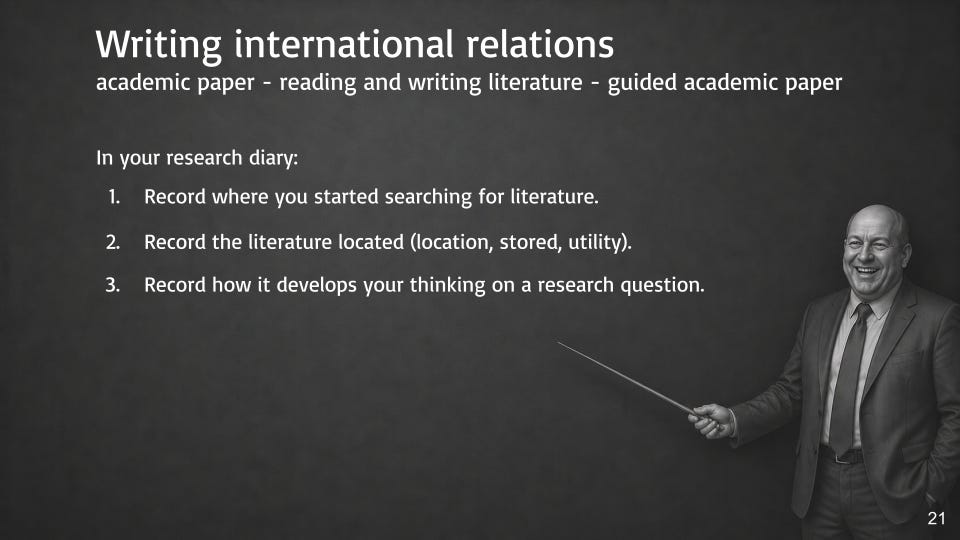
As noted, this course provides for guided research focused on (a) the discipline, (b) the individual, or (c) the nation. At this stage, you are still unlikely to have a final research question, but you probably have an area of interest. That means you can start reading. From this point, record your literature search and reading in your research diary.
Begin with a broad search using Google Scholar, the university library, or an academic database. Try several combinations of keywords related to your topic—and then try several more. Record the search terms you use in your research diary, particularly those that produce useful results.
For example, if you are interested in Korean attitudes towards China, you might search for “South Korea” “China” “public opinion”, “Korean attitudes China”, or “South Korean students China”. Do not worry about finding everything. The immediate objective is to find a small number of articles that appear closely related to your interest.
Next, choose three to five promising articles and read their abstracts and introductions. At this stage, you are trying to understand the shape of the research rather than master the entire literature. Ask simple questions: What are these researchers studying? What questions are they asking? What explanations are they considering? What evidence are they using?
Record each useful article in your research diary. Note its research question, argument, theory, method, evidence, and main findings, together with anything that might be useful for your own project. As you do this, you will begin to see common topics, concepts, methods, and debates.
Next, use these articles to find more literature. Look at their reference lists to identify important earlier studies, particularly works cited repeatedly by several authors. READ THAT AGAIN! This is called “following the bibliographic trail”. Then use Google Scholar or another database to see which later studies have cited those works. Record this trail in your diary, including which articles led you to other useful research.
Do not simply collect PDFs (this is what I often do, and it doesn’t end well). The purpose of reading is to begin mapping the field: what has already been studied, how it has been studied, and what questions remain. Use your research diary to build this map as you read.
After this initial reading, return to your original interest and write a short diary entry explaining how your thinking has changed. Perhaps you have discovered a disagreement in the literature, a group that has received little attention, a method that could be applied differently, or a question that existing studies have not answered.
Reading therefore comes before the final research question: you start with an interest, enter the literature, and allow what you find to help shape the question you eventually ask. Your research diary should provide a record of that process from your first searches to the development of your research question.
Support an academic - Buy me a Coffee