

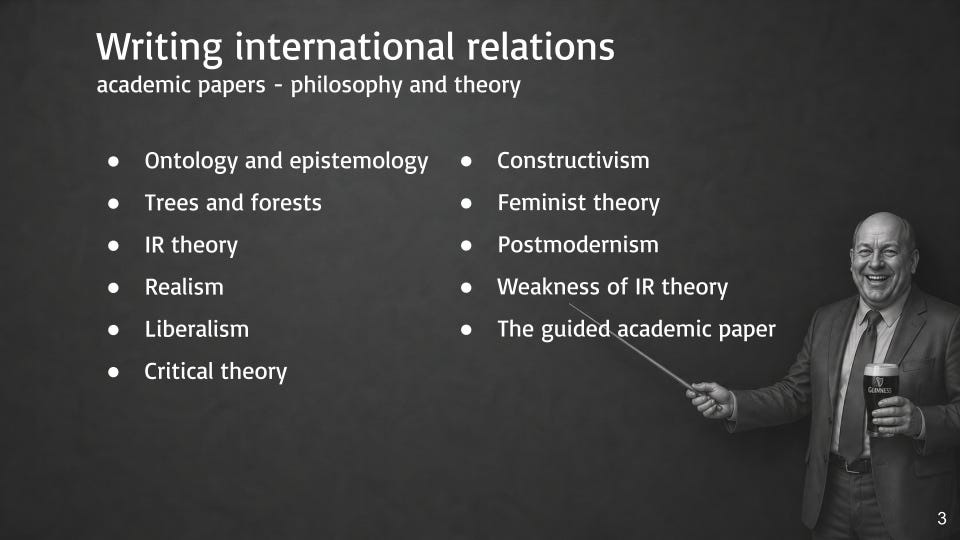
All research begins with assumptions about the world. We make assumptions about what is real, what can be known, and how knowledge can be produced. These assumptions shape the questions we ask, the evidence we consider important, and the methods we use.
Philosophy provides the foundation for these assumptions. Different philosophical traditions understand reality and knowledge in different ways and therefore encourage different approaches to research. How we see the world influences how we choose to study it.
In research methods, these foundations are usually considered through ontology and epistemology:
Ontology - the study of what exists and the nature of reality. In research, it concerns our assumptions about what the social world is and whether it exists independently of our perceptions.
Epistemology - the study of knowledge and how we can know things. In research, it concerns what counts as valid knowledge and how we can acquire knowledge about the world.
So, let’s go through the question “If a tree falls in a forest and no one is there to hear it, does it make a sound?”
Ontology asks what is real, regardless of whether we observe it or not. Epistemology asks a slightly different question--it asks how could we know whether the tree made a sound if nobody was there. So epistemology doesn’t take issue with whether the sound exists or not, but rather how we can create knowledge about it. So let’s reword the question for ontology and epistemology.
Ontology would ask if nobody hears the tree fall, does the sound exist? Epistemology would ask if nobody hears the tree fall, how can we know whether it made a sound. Essentially, ontology is about the tree and the sound and epistemology is about our knowledge of the tree and the sound.
Appears simple, right? But it raises a fundamental philosophical problem: does reality exist independently of our experience of it?
When the tree falls, it creates vibrations in the air. We normally call these vibrations “sound.” But sound can also mean the experience produced when those vibrations reach an ear and are interpreted by a brain. If nobody is present, there are vibrations—but is there actually a sound?
This distinction gives reason to the two broad ontological positions in the social sciences:
A positivist would generally argue that there is a reality independent of the observer: the tree falls and produces measurable physical effects whether anyone observes them or not.
An interpretivist would be more interested in the relationship between reality and human experience. The concept of “sound” has meaning because people experience, describe, and understand those physical events.
In the same way, it illustrates the broad epistemological approaches in the social sciences:
A positivist approach would seek knowledge through observation and measurement: we could place a recording device in the forest and measure the vibrations produced by the falling tree.
An interpretivist approach would ask how people experience and understand “sound,” perhaps finding that different people interpret the same event differently. The basic distinction is therefore between a world that can be objectively measured and a world whose meaning must also be understood through human experience and interpretation.
The basic distinction is therefore between a reality that exists independently and can be objectively studied and a reality whose social meaning must also be understood through human experience and interpretation.
I went to a public school so always thought Raphael was just a ninja turtle but turns out he’s also a painter and did this piece called The School of Athens. So there’s two guys in the center and one is Aristotle who points downward and the other is Plato who points upward.
Aristotle points downward, because he reckons that ultimate reality exists around us, and to discover it, we must examine, classify and explain. Plato points upward because that’s the realm of ideal forms--and he believes ultimate reality can only be discovered beyond the material world and must be approached through reason. Of course, sometime after Plato and Aristotle started talking about such things, these two approaches became known as positivism and interpretivism.
Positivism
Positivism is a philosophical approach based on the idea that reliable knowledge should be grounded in observation, evidence, and systematic reasoning. It assumes that the world exists independently of the researcher and that we can develop knowledge about it by observing patterns, identifying relationships, and testing explanations against evidence.
The philosophical foundations of positivism can be traced back to Aristotle, particularly his emphasis on observation, classification, logic, and the search for causes. Aristotle argued that knowledge of the world could be developed through systematic examination of what exists rather than through abstract reasoning alone. This established an important principle that would later become central to positivist thought: knowledge should be grounded in observable reality.
This emphasis developed through the rise of empirical science, particularly the work of Francis Bacon, who promoted systematic observation and induction as ways of producing reliable knowledge. By the nineteenth century, Auguste Comte developed these ideas into positivism as a distinct philosophy. He argued that society, like the natural world, could be studied scientifically through observation and the identification of regular patterns.
In the social sciences, positivism therefore assumes that a reality exists independently of the researcher and can be systematically investigated. Researchers seek observable evidence, measure phenomena, identify relationships, and test explanations. The ultimate aim is to produce reliable knowledge about how the social world works.
Interpretivism
Interpretivism is a philosophical approach based on the idea that knowledge of the social world requires understanding the meanings people give to their experiences and actions. It assumes that social reality cannot be understood independently of the people who experience and interpret it. Researchers therefore seek to understand how individuals and groups make sense of the world around them.
The philosophical foundations of interpretivism can be traced to traditions that emphasized human experience and understanding. An important early influence was Immanuel Kant, who argued that we do not simply observe the world directly but understand it through the concepts and categories of the human mind. This established an important principle that would later become central to interpretivist thought: our knowledge of reality is shaped by how we perceive and understand it.
This emphasis developed further during the nineteenth and early twentieth centuries, particularly through the work of Wilhelm Dilthey and Max Weber. Dilthey distinguished the study of human society from the natural sciences, arguing that human behaviour required interpretation and understanding. Weber developed this idea through the concept of Verstehen, or interpretive understanding, emphasizing the need to understand the meanings that individuals attach to their actions.
In the social sciences, interpretivism therefore assumes that social reality is shaped by meanings, beliefs, identities, and experiences. Researchers seek to understand these meanings through interpretation rather than simply measuring observable behaviour. They commonly examine interviews, texts, language, historical records, and social practices. The ultimate aim is to understand how people interpret and construct the social world in which they live.
Positivism and interpretivism and Thucydides
The Melian Dialogue in Thucydides’ History of the Peloponnesian War provides a useful way of illustrating the difference between positivism and interpretivism. In the dialogue, Athens demands that the small island of Melos submit to Athenian power. The Melians refuse, appealing to justice, independence, hope, and the possibility of assistance from Sparta. Athens responds that questions of justice have little relevance when power is unequal: “the strong do what they can and the weak suffer what they must.”
A positivist approach treats the dialogue as evidence of observable patterns in international politics. Athens is materially stronger than Melos; Melos cannot defend itself; there is no higher authority capable of protecting it. The outcome can therefore be explained through variables such as power, military capability, interests, and the absence of effective external protection.
An interpretivist approach asks instead how Athens and Melos understood the situation. Athens constructs itself as a great power whose survival and reputation require Melian submission. The Melians understand themselves as an independent community for whom surrender has meanings beyond physical survival. Their arguments invoke justice, honour, identity, hope, neutrality, and expectations about Sparta.
Positivist reading Interpretivist reading Athens has greater material power Actors interpret what power means Military capabilities determine possibilities Identity and beliefs shape perceived possibilities Melos is objectively weaker Melos believes Spartan kinship matters External assistance can be assessed materially Alliance obligations have socially constructed meanings Outcome demonstrates consequences of power imbalance Behaviour reflects honour, justice, identity, belief and expectations
The Melian Dialogue provides a bridge from philosophy to theory. The same event can be understood differently depending on the assumptions we make about what matters and how we can know it.
If material power is treated as the central reality of international politics, we are likely to develop theories that explain behaviour through capabilities, interests, and constraints. If identities, beliefs, and meanings are treated as important parts of that reality, we require theories that explain how actors understand and construct their world. IR theory therefore builds upon philosophical assumptions, turning different ways of seeing the world into systematic explanations of international politics.
International relations theory
International Relations (IR) theory provides different ways of understanding and explaining international politics. Theories identify what matters, make assumptions about how the international system works, and provide concepts that help us interpret events. Realism, liberalism, constructivism, and other approaches can therefore produce very different explanations of the same event.
IR theory is a large and complex field, and it cannot be covered comprehensively in a research methods course. A full understanding requires a dedicated study of the major theoretical traditions, their development, debates, and differences. These are my preferred resources, if you want to go further.
In this course, the purpose is more limited: to understand how theory connects philosophical assumptions to research, shaping the questions we ask, the explanations we develop, and the evidence we use. So, there is only a need for a cursory introduction to the realist, liberal, critical, constructivist, feminist, postmodernist, and practice approaches--these and their derivations are what you’ll see over and over in academic papers as you prepare your own.
Realism in IR
Realism is one of the oldest and most influential ways of thinking about international politics. Its intellectual roots are commonly traced from Thucydides, through Machiavelli and Hobbes, to twentieth-century thinkers such as E. H. Carr and Hans Morgenthau. Despite considerable differences between these thinkers, they share a concern with the realities of power, conflict, security, and political necessity.
Modern realism developed these ideas into theories of international politics centred on states competing for security and influence in an international system without a central authority. Realism therefore provides a way of explaining international politics by focusing on power, national interest, survival, and the constraints facing states. In summary:
States are the principal actors in international politics.
The international system is anarchic — there is no authority above states.
States must therefore rely on self-help to ensure their survival.
Survival and security are the fundamental interests of states.
Power, particularly military power, is central to international politics.
States generally behave rationally and strategically in pursuing their interests.
Differences in the distribution of power help explain state behaviour and international outcomes.
Conflict and competition are persistent features of international politics.
Realism seeks to identify general patterns and explanations, making modern realist research closely associated with positivist approaches.
Liberalism in IR
Liberalism is another major tradition in International Relations, emphasizing the possibilities for cooperation, progress, and peaceful relations between states. Its intellectual roots are commonly traced through John Locke, Adam Smith, and Immanuel Kant, whose work emphasized individual liberty, commerce, political institutions, and the possibility of progress through reason.
Modern liberalism developed these ideas into theories examining how domestic politics, economic interdependence, democracy, and international institutions influence state behaviour. Liberalism therefore provides a way of explaining international politics by looking beyond the distribution of power to the institutions, interests, economic relationships, and domestic characteristics that shape relations between states. In summary:
States are important actors, but they are not the only important actors in international politics.
International politics is anarchic, but cooperation remains possible.
States pursue a variety of interests, including security, prosperity, and economic development.
International institutions can facilitate cooperation and reduce uncertainty between states.
Economic interdependence and trade can influence state behaviour and increase the costs of conflict.
Domestic institutions and political systems can shape foreign policy.
Individuals, businesses, international organizations, and other non-state actors can influence international outcomes.
Conflict is possible, but cooperation and progress are also persistent features of international politics.
Modern liberal theories generally seek to identify causal relationships and general patterns, meaning that much mainstream liberal research also operates within a broadly positivist tradition.
English School in IR
The English School (weirdly named as half of them were Australian) is a major tradition in International Relations that focuses on how states create and maintain order in international politics. Its intellectual roots are commonly traced through Hugo Grotius and other writers on international law and diplomacy, while its modern development is associated with thinkers such as Martin Wight, Hedley Bull, and Adam Watson. Unlike realism, which emphasizes competition under anarchy, the English School argues that states form a society based on shared rules, institutions, and practices.
Modern English School theory developed these ideas around the concept of international society. Although there is no central authority above states, states recognize common interests, accept certain rules of conduct, and participate in institutions such as diplomacy, international law, the balance of power, war, and great-power management. The English School therefore provides a way of understanding how anarchy and international order can exist at the same time. In summary:
States are the principal actors in international politics.
The international system is anarchic — there is no authority above states.
States nevertheless form an international society when they recognize common interests, rules, and institutions.
International order is maintained through established institutions and practices.
Diplomacy and international law provide rules and mechanisms through which states manage their relations.
The balance of power and great powers can play important roles in maintaining international order.
War remains part of international society but is also shaped and constrained by rules and practices.
Sovereignty and non-intervention are important principles governing relations between states.
International society can develop beyond coexistence towards greater cooperation and concern for individuals, rights, and justice.
The English School is generally less closely associated with positivism than mainstream realism and liberalism, often drawing on historical, interpretive, and normative approaches to understand the rules, institutions, and practices of international society.
English School theory just seems to make more sense, IMO. It kinda combines a few elements to blunten the sharp edges of the others.
Critical theory in IR
Critical theory provides a different approach to International Relations by questioning the political, economic, and social structures that are often taken for granted. Its intellectual roots are commonly traced through Karl Marx, and later the Frankfurt School, particularly thinkers such as Max Horkheimer and Jürgen Habermas.
In IR, scholars such as Robert Cox developed these ideas by asking how existing theories reflect particular historical circumstances and relations of power. Rather than simply explaining how the international system works, critical theory asks whose interests the existing system serves, how structures of power are created and maintained, and how they might be changed. It therefore places particular emphasis on power, inequality, historical change, and the possibility of emancipation. In summary:
Political and social structures are historically created rather than natural or inevitable.
International politics cannot be understood solely through states and material power.
Economic, social, political, and ideological forms of power shape international relations.
Ideas and institutions can help create and maintain existing relations of power.
Researchers should question concepts and institutions that are normally taken for granted.
Theory itself is not necessarily neutral and may reflect particular interests and historical circumstances.
Critical approaches often ask whose interests are served by existing arrangements.
Research should examine possibilities for change and emancipation, rather than simply explain the existing system.
Critical theory is commonly associated with interpretivist and post-positivist approaches, although critical scholarship encompasses a wide range of philosophical positions.
Constructivism in IR
Constructivism emerged as a major approach to International Relations during the late twentieth century, particularly through the work of scholars such as Nicholas Onuf, Friedrich Kratochwil, and Alexander Wendt. It developed partly in response to realist and liberal approaches that tended to treat states, interests, and the international system as largely given.
Constructivism instead argues that international politics is also shaped by ideas, identities, norms, beliefs, and shared understandings. States act according to how they understand themselves, other actors, and the world around them. International reality is therefore not simply determined by material conditions but is also socially constructed through interaction and interpretation. In summary:
International politics is shaped by both material and social factors.
Ideas, identities, norms, and beliefs influence state behaviour.
State interests are not simply given; they are formed through social and political processes.
How states perceive other states influences how they respond to them.
The meaning of power, threats, alliances, and security depends partly on interpretation.
International norms can shape what states consider appropriate or legitimate behaviour.
Interaction between states can change their identities and interests over time.
International structures are produced and reproduced through social interaction.
Constructivism has strong connections with interpretivism, although some constructivist research also adopts positivist approaches to explanation and evidence.
Feminism in IR
Feminist approaches became increasingly influential in International Relations from the 1980s, particularly through scholars such as Cynthia Enloe, J. Ann Tickner, and Christine Sylvester. Feminist theory challenged traditional IR for treating international politics as largely gender-neutral while concentrating on states, war, diplomacy, and military power—areas historically dominated by men. It argues that gender is an important part of how international politics is organized and understood.
Feminist scholars examine how ideas about masculinity and femininity shape concepts such as power, security, leadership, and conflict, while also drawing attention to experiences and forms of political activity often overlooked by conventional theories. In summary:
Gender matters in understanding international politics.
International politics is not necessarily gender-neutral.
Traditional IR has often privileged the experiences and perspectives of men.
Ideas about masculinity and femininity can shape political behaviour and institutions.
Concepts such as power and security can have gendered meanings.
War and conflict can affect men and women differently.
Everyday experiences can reveal dimensions of international politics overlooked by state-centred approaches.
Feminist research asks whose experiences and voices are included or excluded from conventional accounts.
Feminist IR includes diverse approaches, including liberal, critical, constructivist, and poststructuralist feminism, rather than representing a single philosophical position.
Postmodernism in IR
Postmodernist approaches became influential in International Relations during the 1980s and 1990s, drawing particularly on thinkers such as Michel Foucault, Jacques Derrida, and Jean-François Lyotard, and in IR on scholars such as Richard Ashley and David Campbell. Postmodernism questions the assumption that international politics can be understood through a single objective account of reality. Instead, it examines how language, discourse, knowledge, and representations help construct political reality.
Categories commonly used in IR—such as security, sovereignty, threat, identity, and even the state—are therefore treated not simply as objective facts but as concepts whose meanings are produced and contested. Postmodernist research consequently asks how particular descriptions of the world become accepted as true and how those descriptions create or reinforce relations of power. In summary:
There is no single, neutral way of representing international politics.
Language and discourse help construct political reality.
Knowledge and power are closely connected.
Concepts such as security, sovereignty, identity, and threat should be questioned rather than taken for granted.
Political actors construct identities through distinctions such as self/other, inside/outside, and normal/dangerous.
Dominant narratives can make some interpretations appear natural or inevitable while excluding alternatives.
Researchers examine how particular forms of knowledge become accepted as authoritative or true.
Research often focuses on texts, speeches, representations, narratives, and discourse.
Postmodernist IR is strongly associated with post-positivist and interpretivist approaches and is generally sceptical of universal theories and objective claims to knowledge.
IR as a practice
IR as a practice became increasingly influential in International Relations from the 2000s, drawing on thinkers such as Pierre Bourdieu, Anthony Giddens, and Michel de Certeau, and developed in IR by scholars including Emanuel Adler, Vincent Pouliot, and Iver Neumann. Practice “theory” shifts attention from what international actors say or formally decide to what they actually do in their everyday activities.
International politics is understood as being produced through repeated practices—such as diplomacy, negotiation, military planning, intelligence gathering, and participation in international organizations. Many of these practices depend on practical knowledge, professional routines, and shared understandings that actors may rarely articulate explicitly. Practice theory therefore examines how international politics is created and reproduced through everyday actions, routines, skills, and interactions. In summary:
International politics is produced through what actors routinely do.
Researchers examine practices, rather than focusing only on formal decisions, institutions, or ideas.
Practices include activities such as diplomacy, negotiation, military planning, and intelligence work.
Actors develop practical knowledge and skills through experience.
Much political behaviour is routine or taken for granted, rather than the result of conscious calculation.
Professional communities develop shared rules, habits, expectations, and ways of doing things.
Repeated practices can create and reproduce institutions and international order.
Practices can also change, producing wider political and institutional change.
Practice theory is commonly associated with interpretivist and constructivist approaches, although it includes a range of different philosophical traditions.
IR as a practice is, in my opinion, the best explanation. When it comes down to it, negotiations end because negotiators are tired; wars start because leaders are stupid and proud; and traditions continue because no public servant wants anything to upset the safety of their salary for life and a decent retirement benefit at the end.
The weakness of IR theory
Like all social science theories, IR theories simplify reality in order to make it understandable. They do this through several basic components: assumptions, concepts, relationships, and units of analysis. Understanding the components of theory help you to see parallels between IR theory and other social sciences disciplines.
The components of theory
Assumptions
Background assumptions
Tractable assumptions
Concepts
Relationships
Units of analysis
Assumptions provide the starting point for a theory. Background assumptions are broad beliefs about how the world works, such as whether people behave rationally or whether states seek security. Tractable assumptions are deliberate simplifications that make a problem easier to study. For example, a theory might treat the state as a single actor even though governments contain many competing individuals and institutions. Such assumptions make complex problems manageable, but they inevitably leave some aspects of reality aside.
Concepts identify and define the things that a theory considers important. In IR, these might include power, security, sovereignty, identity, institutions, or norms. Concepts allow researchers to turn complex features of international politics into categories that can be discussed, compared, and sometimes measured. Different theories often emphasize different concepts or define the same concept in different ways.
Relationships describe how these concepts are connected. A theory does more than identify power, conflict, trade, or institutions; it proposes relationships between them. Realist theories might examine how changes in the balance of power affect conflict, while liberal theories might examine whether economic interdependence encourages cooperation. These proposed relationships allow theories to move from simply describing the world toward explaining why particular outcomes occur.
Finally, the unit of analysis determines where a theory looks for explanation. International politics can be examined at the level of the individual, the state, or the international system. A researcher might explain a war through the decisions of a particular leader, the domestic characteristics of a state, or the distribution of power across the international system. Other theories might focus on institutions, classes, gender, communities, discourses, or practices. The choice of unit of analysis therefore shapes both what a theory can explain and what it is likely to overlook.
Any theory begins with assumptions about how the world works, identifies concepts that it considers important, proposes relationships between those concepts, and selects the actors or processes that should be studied. These choices allow theories to explain complex events, but they also create limitations.
Every theory therefore highlights some aspects of international politics while overlooking others. Its assumptions may simplify how actors behave; its concepts may be difficult to define or measure; the relationships it proposes may not hold across every case; and its chosen unit of analysis may exclude important explanations operating at other levels. Realism, for example, may focus on states, power, and the relationship between capabilities and behaviour, while paying less attention to individuals, identities, or everyday political practices.
The weakness of theory is therefore also part of its usefulness. A theory cannot reproduce the full complexity of the world—it must simplify it. The important task for researchers is to understand what a theory assumes, what concepts it uses, what relationships it proposes, and what unit of analysis it privileges. This allows us to judge both what a theory can explain and what it may leave unexplained.
If you read this far, you’re pretty impressive. Sometimes I kind of tune out when I’m reading and think of other things while the words are going in, then a few paragraphs later I realize, heck, I was thinking about dinner instead of reading. So kudos to you.
The guided academic paper - philosophy and theory
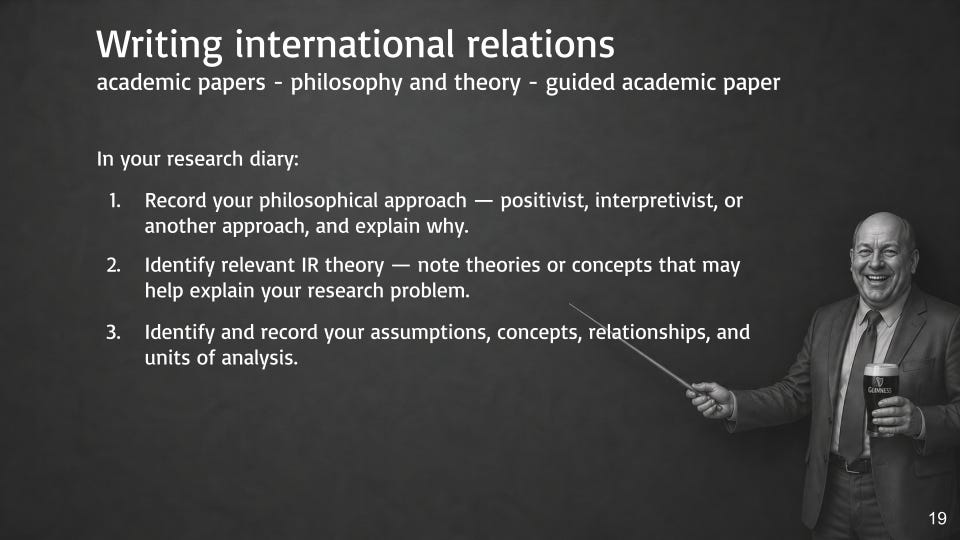
As you develop your guided academic paper, you should begin thinking about the foundations of your own research. Work through each of the following questions in your research diary and record your answers. These entries will provide a record of the decisions you make as your research develops.
First, in your research diary, record your philosophical approach. What assumptions are you making about the world you are studying, and what kinds of evidence will allow you to answer your question? Consider whether your research is primarily seeking to explain observable patterns (positivist) or understand meanings and interpretations (interpretivist), and briefly explain why.
Second, record how IR theory relates to your research. Consider whether realism, liberalism, constructivism, critical theory, feminism, practice theory, or another approach helps guide how you understand the problem. You do not need to force your research into a particular theory. Instead, note any theoretical concepts, assumptions, or explanations that may be useful to your research.
Finally, record the basic components of your research. Identify your main concepts, the relationships you are interested in, the assumptions you are making, and your unit of analysis. For each, briefly note how it relates to your research question and the evidence you might need.
These entries are not expected to be final. Philosophy and theory can initially seem abstract and overly academic, but they have practical consequences for research. As your project develops, return to these entries and revise them. Your research diary should show how your thinking about your question, theory, evidence, and research design develops over time.
Support an academic - Buy me a Coffee