
From Trump's nice little excursion to WW3?
If 1991 Iraq strained the boundary between reality and representation, then 2026 Iran has obliterated it entirely.

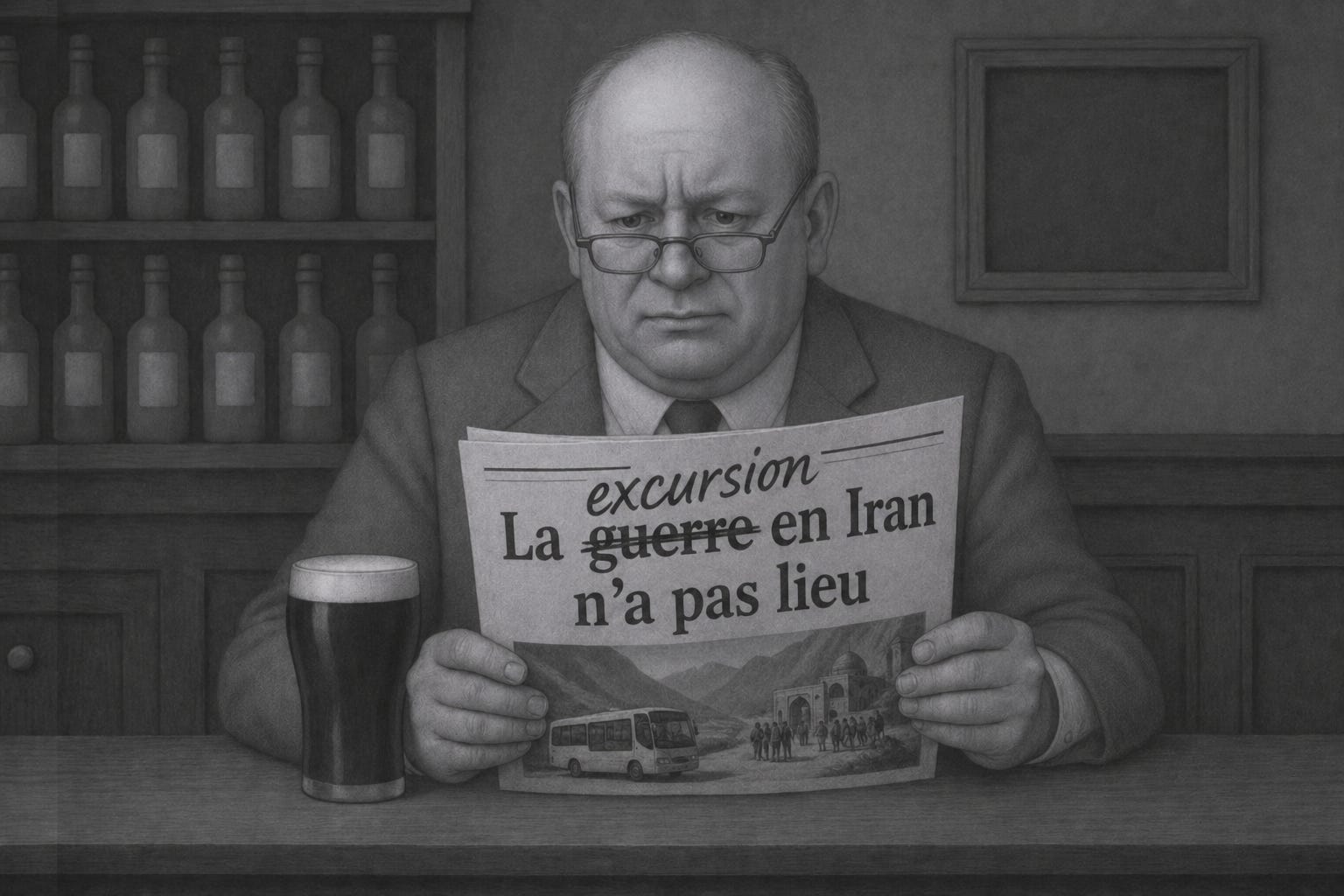
In 1991, Jean Baudrillard published a series of essays that would later be collected under the deliberately provocative title The Gulf War Did Not Take Place. The trilogy appeared first as three separate pieces: “The Gulf War Will Not Take Place”, “The Gulf War Is Not Taking Place”, and “The Gulf War Did Not Take Place”. All three were originally published in the French newspaper Libération in early 1991, before being compiled into book form by Éditions Galilée (and later Indiana University Press).
Taken together, they formed a single argument: that what the world experienced as “war” in Iraq in 1991 was less a conventional conflict than a mediated event—structured, filtered, and ultimately transformed by representation. Baudrillard would not just be spinning in his grave at the Iran war—he would be vindicated, horrified, and perhaps, perversely, unsurprised.
If 1991 Iraq strained the boundary between reality and representation, then 2026 Iran has obliterated it entirely.
To begin with, it’s not a war. It’s a “military operation,” “major combat operations,” “hostilities in the Middle East,” or even “a nice little excursion.” I mean sure, America has used all the instruments of war, and the entire debacle is led by a dumb-ass that bizarrely called himself Secretary of War, but it’s not a war. This is precisely where Baudrillard would begin. Not with destruction, but with the instability of meaning.
In The Gulf War Did Not Take Place, Baudrillard argued that modern war had already shifted from a material event into something mediated, narrated, and ultimately controlled through representation. The Iran war pushes that logic further. It begins not with simulation, but with semantic evasion.
In 1991, Baudrillard’s provocation was that the Gulf War, as experienced by Western audiences, was not war in any meaningful sense. It was a radically asymmetrical operation—technological dominance rendered into a clean, televisual narrative. War appeared as something coherent: it had a beginning, a middle, and an end. Even if the representation distorted reality, it still imposed form on it.
The 2003 Iraq War stretched that form, but did not destroy it. It became a longer, messier narrative—still mediated, still structured, still presented as something that could be understood as “war,” even if poorly.
The Iran conflict goes a step further. Across the globe we wake in the morning look at our phones and wonder what hell debacle has unfolded and then scoff that it’s just a few clumsy presidential threats or dementia-fed missives on victory, depending which way the market is turning. We don’t know whether it’s on or off. And when it is on, save for a few of us with relations directly involved, we won’t experience it first hand. So the conflict exists materially, but not formally. It is fought, but not declared. It is acknowledged, but not defined.
Even reports of mass civilian death—such as the killing of over 160 school children, are attributed not to deliberate intent but to algorithmic error or AI-assisted targeting. There is no sustained moral or political rupture in Western media. Instead, they are reframed: as technical malfunction, as intelligence failure, as the regrettable by-product of otherwise precise systems. Responsibility is diffused into process. The event is not denied, but it is rendered weightless—circulated briefly, explained away, and then displaced by the next cycle of content.
In Baudrillard’s terms, the horror is neither fully confronted nor hidden; it is translated into a form that can be consumed without consequence.
Baudrillard argued that the Gulf War “did not take place” because it was experienced as simulation, but the Iran war presents a stranger inversion: it takes place continuously, and yet is withheld from existence through language. Not simulated into being, but linguistically denied.
This produces a different kind of distortion. In the Gulf War, representation replaced reality with a coherent image. In Iran, representation fails to stabilise reality at all. The administration insists it is not a war. Congress debates whether it is. Legal arguments recast it as an extension of prior authorizations rather than a new conflict. The terminology shifts depending on audience and necessity.
The result is not clarity, but fragmentation. There is no single narrative, not even a misleading one. There are multiple, competing descriptions that never converge. The conflict becomes difficult not just to interpret, but to categorise. And once categorisation breaks down, so too does accountability.
This is not a trivial issue of wording. The War Powers framework depends on classification. A war triggers timelines, reporting requirements, and limits. An “operation” does not. By refusing the term, the system avoids the obligations attached to it. Language becomes a mechanism of evasion.
Baudrillard feared that modern war would become spectacle—absorbed into media, stripped of consequence. That has happened, but it is no longer the most important feature. The Iran war is not simply aestheticised through footage, clips, and curated imagery. It is structurally undefined. The spectacle remains, but it floats on top of something more fundamental: the collapse of meaning.
There is no longer even an attempt to impose narrative coherence. Objectives shift. Justifications mutate. Victory conditions remain unclear or unstated. The conflict persists as an ongoing condition rather than a bounded event. It does not move toward resolution so much as continue to generate itself—politically, militarily, and rhetorically.
Baudrillard’s critics accused him of denying reality, of turning war into abstraction. But the Iran war reveals the sharper edge of his argument. He was not saying that war does not happen. He was saying that, for those who experience it through systems of representation, it no longer exists as war in any stable sense.
What we are seeing now is not simply hyperreality, but something closer to semantic collapse. A war that must be fought, but cannot be named. A reality that is materially undeniable, but politically indeterminate.
If the Gulf War “did not take place” because it was reduced to a spectacle, the Iran war does not take place because it is dissolved into language.
And that is worse. Because once a war cannot be named, it cannot be limited, ended, or even properly understood.
And this is where the question becomes unavoidable. If war no longer needs to be declared to be fought, if catastrophe can be reframed as malfunction, if escalation is absorbed into an endless stream of “operations,” “responses,” and “incidents,” then what exactly would it look like to enter a third world war? Not with a declaration, not with a rupture, but with a drift. Not as an event, but as an accumulation.
Baudrillard warned that representation could replace reality; what we are confronting now is more insidious—that reality advances while language lags behind, hollowed out and repurposed to manage rather than describe. Here lies the real threat.
The danger is not that we will not recognise the moment and fail to act. It is that there will be no moment at all. That we will slip into something far larger, far more consequential, without ever quite naming it—because the words required to do so no longer mean anything.