
Korea's democracy is stronger in the West
For outsiders, the impeachment and prosecution of Yoon shows democratic strength. For insiders, the polarization and extremism still remain and show frightening democratic weaknesses.

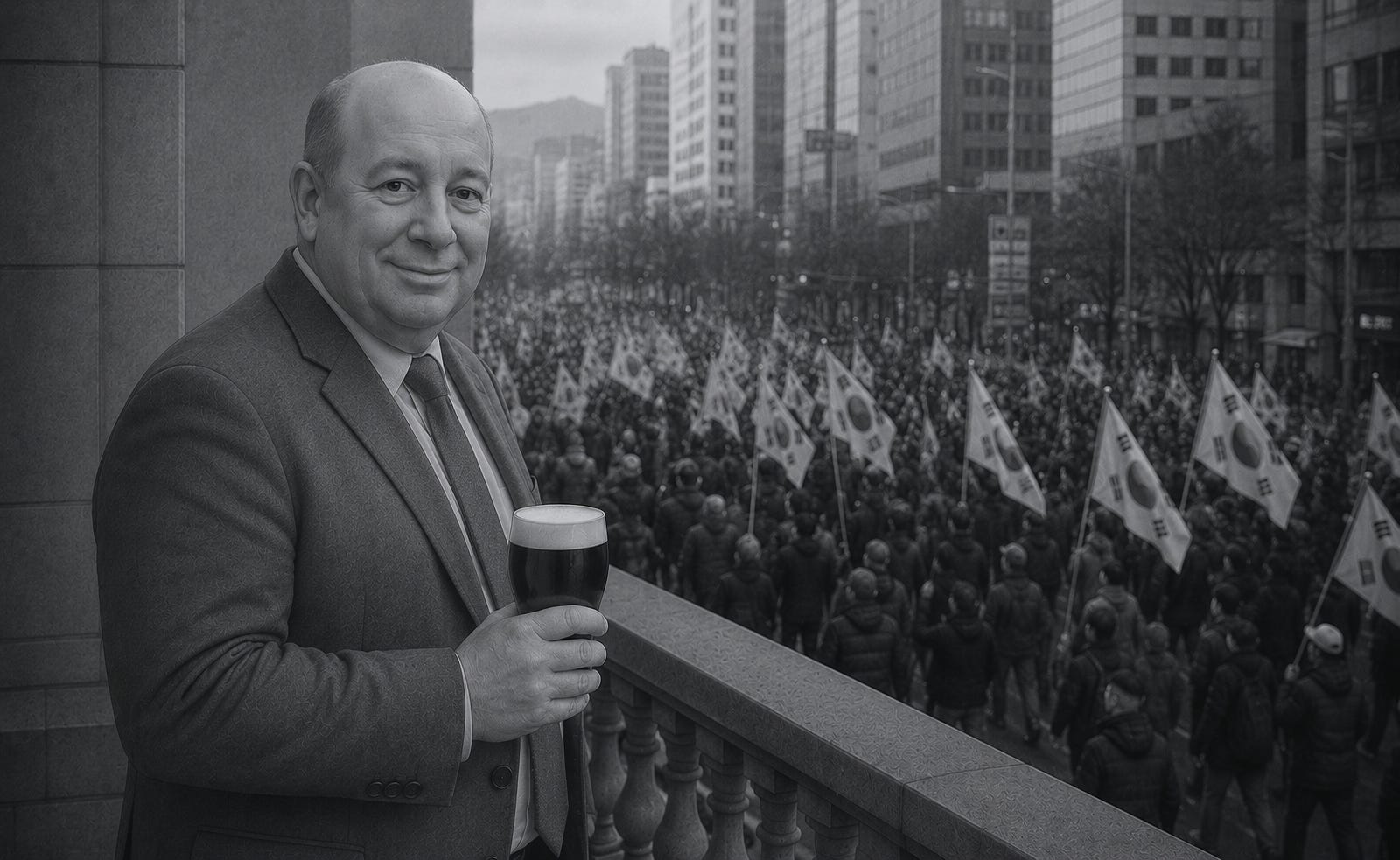
The protests following South Korea’s recent ballot mix-up are still going. Sure, you’ve seen similar protests before, talked to a few protesters, tried to work out what it’s all about, and know that generally, they're loopier than a bowl of Froot Loops. The difference this time is that the bowl is bigger, the colors are brighter, and the loops are absolutely furious.
As always, it’s the extreme views that most interest me.
On the political far right, the ballot mix-up was immediately interpreted as evidence of election fraud. For the more committed believers, it was not simply an isolated mistake but proof of preparations for manipulation during the next presidential election coupled with Chinese influence. The incident fitted neatly into an existing narrative that South Korean democracy has already been compromised by hidden actors operating behind the scenes.
On the political far left, an equally dramatic interpretation emerged. The protests themselves—and particularly their persistence—were presented as evidence that something much larger is underway. Suspicious foreign funding, outside influence, and the slow construction of a future “color revolution” organized by the U.S. deep state. In this telling, the demonstrations were not primarily about ballots but setting the stage for the destabilization the political system itself.
The details differ, but the underlying extreme logic is remarkably similar. At the extremes, both sides increasingly view political opponents not as fellow citizens who happen to hold different opinions, but as participants in a foreign conspiracy. The assumption is no longer that mistakes occur, institutions fail, or people disagree. The assumption is that hidden forces are always at work.
Korean history tells us where this logic can lead. In the late nineteenth and early twentieth centuries, the Korean Peninsula became the object of intense competition among foreign powers, including China, Japan, Russia, and later the United States. These powers did not merely compete from afar. They cultivated allies, clients, and sympathizers within Korea itself. Reformers, conservatives, nationalists, royalists, and collaborators often aligned with different external actors, convinced that foreign support offered the best path to protecting their vision of the country’s future.
The end result was not national unity but deep internal division that ultimately weakened Korea’s ability to resist external pressure and contributed to the loss of its independence. The lesson is not that foreign influence is imaginary. It is that societies become most vulnerable when political rivals are assumed to be agents of foreign powers rather than fellow citizens with competing ideas about the national interest.
It is a scary thought. Modern history says so. It not too long ago, let’s say two decades or at least a comb-over ago, people around the world have seen foreign governments, international organizations, media outlets, NGOs, intelligence agencies, and transnational activist networks accused—sometimes plausibly, sometimes implausibly—of influencing domestic politics. The color revolutions in Georgia and Ukraine, the Arab Spring uprisings in Egypt and elsewhere, and the NATO intervention in Libya all became symbols in a broader global debate about sovereignty, regime change, and external influence.
Ukraine provides the clearest modern example of how domestic politics can become entangled with great-power competition. Russia on one side, the United States and Europe on the other, have sought to influence Ukraine’s political direction. To some, it’s legitimate diplomatic engagement and support for democratic development. To others, it’s evidence of external interference in a sovereign state’s affairs. Whatever interpretation, the result is that Ukraine’s internal political divisions ultimately led to war. Why? Because it was a contested strategic pivot and neither Russia nor the West wanted to lose their control.
And Korea? Suddenly the outside interference schtick don’t seem so implausible. For a country like South Korea, situated at the intersection of competing great powers, the lesson is an uncomfortable one.
South Korea’s political crisis did not begin with a ballot mix-up, nor did it end with the impeachment and prosecution of former president Yoon. The events surrounding martial law were interpreted overseas as evidence of democratic resilience. The military did not take power. The constitutional system functioned. Political leaders were held accountable. From a procedural perspective, democracy appeared to work. This interpretation confuses the resolution of the crisis with the resolution of its causes.
The political division, extremism, and mutual suspicion that helped create the conditions for the crisis remain firmly embedded within South Korean society. Public trust is low. Political identities are increasingly tribal.
Conspiracy theories that once occupied the fringe now circulate openly within mainstream political communities. Every controversy is rapidly absorbed into larger narratives of betrayal, subversion, and existential threat.
The ballot controversy is less significant for what it reveals about election administration than for what it reveals about South Korean politics. It shows that the polarization visible during the martial law crisis has not disappeared. If anything, it has become further entrenched.
For outside observers, the temptation is to view South Korea’s recent turmoil as a completed chapter—a stress test that ultimately demonstrated democratic strength. The reality is less reassuring. The institutions survived, but many of the social and political forces that pushed the country toward that crisis are still present.
Sooner or later, they will find a new issue, a new controversy, and a new opportunity to emerge once again. The risk of escalation remains.
—
Support my writing please, please, please! - Buy Me a Coffee!