
Middle power nostalgia is not a strategy
Albanese and Carney's actions suggest not a belief that middle power diplomacy can return, but more a belief that the 1990s can return.

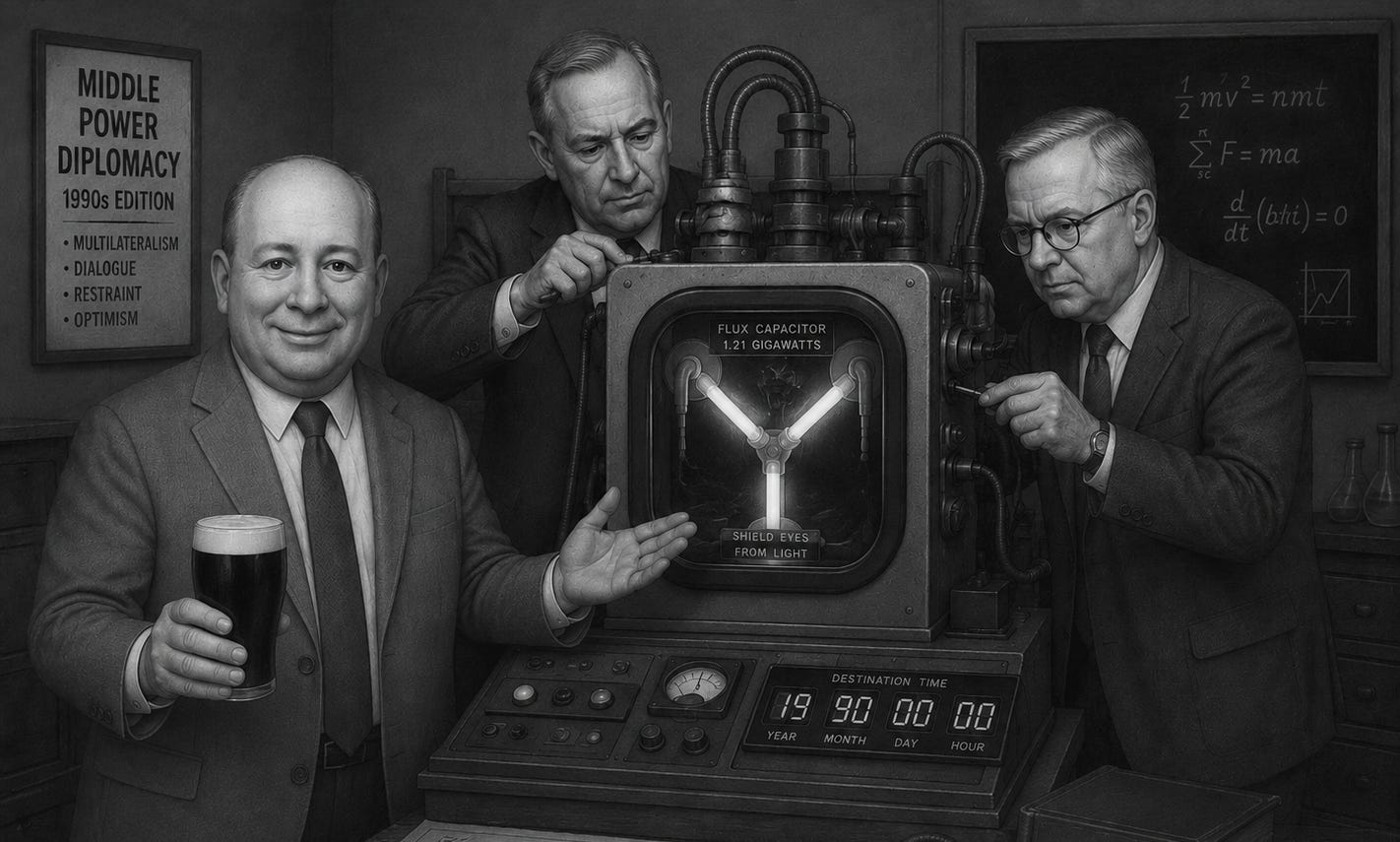
The Iran conflict has revealed something awkward about the foreign policy instincts of Australia and Canada. Their leaders, Anthony Albanese and Mark Carney, respectively, wibble on about norms and values, international law, sovereignty, multilateralism, and what they call “middle power diplomacy”. Yet, they never waiver from routine declarations condemning Iran and supporting the U.S.
That’s pretty weird. Their responses to the Iran conflict suggest something else entirely: not a belief that middle power diplomacy can return, but more a belief that the 1990s can return.
Maybe Carney and Albanese have secretly worked on a time machine and know something we don’t?
The Canadian and Australian responses to the Iran crisis are detached from reality. They sound less like countries grappling with a collapsing regional order and more like exhausted caretakers trying to preserve the final pages of a fading rules-based instruction manual. Calls for restraint, de-escalation, dialogue, and international law are delivered with the ritualistic confidence of states that still assume history ultimately bends back toward managed globalization and American-led stability.
Their positions are actually diminished echoes of earlier eras. The Australian and Canadian approaches in 2025 are pale representations of their positions during the Iraq War debates of 2003—when middle powers at least still believed they possessed some capacity to shape American behavior or influence coalition legitimacy. And those 2003 positions were themselves pale reflections of the optimism of 1991, when the end of the Cold War briefly convinced Western middle powers that history had entered an era where process, institutions, and economic integration could gradually tame geopolitics itself.
That era is dead. Well dead. It’s been dead for a very long time.
The intellectual architecture of middle power diplomacy is now a vintage spitball. In the 1990s, it was a formidable classroom weapon. In the 2000s, it was a memory left stuck high up on the wall that nobody bothered cleaning up. In the 2010s it grew mold and lost its original form. Today it’s just a spread out dark mess from another era that needs to be sanded down and painted over.
What makes this especially strange is that the contemporary strategic environment actually demonstrates that middle powers do matter.
The Ukraine war showed that a non-great power state — with sufficient mobilization, industrial adaptation, strategic will, and external support — can contest a major power (at great cost to itself) within its immediate region. Iran has demonstrated something similar in different form. Despite sanctions, isolation, technological constraints, assassination campaigns, and repeated military pressure, Iran has proven capable of imposing a significant strategic rebalancing of its region - unless the great power decides on actions of even greater approbation.
Neither Ukraine nor Iran “won” in the simplistic triumphalist sense often demanded by television commentary. That is beside the point. The point is that both demonstrated agency. Both demonstrated endurance. Both demonstrated that middle powers can shape escalation, impose costs, complicate deterrence, and force adaptation from far stronger adversaries.
Ironically, this should have been the moment for middle power theory to evolve and mature.
Instead, much of the Canadian and Australian foreign policy establishment has retreated into nostalgia.
One sees the same genre of op-ed recycled across newspapers, think tanks, and policy journals: former ministers, retired diplomats, and aging academic stalwarts yearning for the supposed golden age of constructive multilateralism.
The tone is less analytical than therapeutic. The 1990s are remembered not simply as a strategic period, but as an emotional condition — a time when Western middle powers believed they were morally relevant, economically secure, and protected indefinitely by uncontested American primacy.
I am most familiar with Australia’s middle power nostalgia, so what catches my eye is the routine turn to a Gareth Evans op-ed. As foreign minister, Gareth Evans led Australia to the pinnacle of its middle power prowess in the 1990s - the “plucky country” standing at centre of the world stage at APEC, the Cambodia Peace Process, the Canberra Commission, the Cairns Group, and of course, the very concept of “good international citizenship”. Undoubtedly, his work was great.
The Gareth Evans op-ed returns every few months to recall the greatness of the middle power era and the hope that it can return. This will be followed by a chorus of other similarly in-tune op-eds recalling the era when Western middle powers were at the top of the pile.
It’s strange. When we talk about modern technology, we rarely bring up the 1980s TV Rentals Guy, Joe Hasham, and the bargains available at Electronic Sales and Rentals (Australians of an appropriate age may know who I’m talking about). Why do we feel the need to dredge up an era more than 30 years out of date? It’s like someone bringing up the 1950s as guidance to behavior during the formation of APEC!
Nostalgia is not strategy!
The world is now harsher, more regionalized, more industrial, more militarized, and more technologically fragmented. Geography matters again. Industrial capacity matters again. Demography matters again. Long-term strategic thinking, more than anything else, matters again.
And yet Australia and Canada still often behave as if carefully worded statements alone remain meaningful demonstrations of strategic agency.
The tragedy is that both countries possess the foundations for something more serious.
Australia sits within the Indo-Pacific — the central theater of twenty-first century geopolitics. Canada possesses enormous Pacific and Arctic relevance, industrial potential, energy resources, and geographic insulation. Both are wealthy democracies with the capacity to build appropriate technological sectors and industrial bases. Both could help pioneer a new form of middle power strategy centered not on moral brokerage, but on resilience, industrial capacity, regional leverage, strategic hedging, and selective autonomy within alliance systems.
That would require abandoning the comforting mythology of the 1990s. Middle power diplomacy in the future cannot simply mean writing elegant communiqués while quietly waiting for Trump to be removed from office.
It must instead grapple with a world where great powers openly contest regions, supply chains weaponize interdependence, and middle powers increasingly survive through endurance, adaptability, and strategic realism. Middle powers thrive by adapting to the structure of the system, not by imagining or hoping for a long past system’s revival.
The real lesson of Ukraine and Iran is not that middle powers are irrelevant. It is that they matter more than many expected — but in ways the old middle power literature barely understood.
Until Australia and Canada recognize this, they will remain trapped reenacting the emotional memory of a vanished era: wistfully rehashing the feel-good certainties of the 1990s while the world around them moves on without them. Trapped reenacting a bygone era, and increasingly irrelevant.
—
Support, share, comment, and/or subscribe - Buy Me a Coffee!
Interesting read, thanks. You acknowledge greater familiarity with Australia, but never really demonstrate the naivetee or backwards-looking approach of Carney. Carney does appear to be going beyond mere platitudes from the past and demonstrating a vision for international politics under a new structure. He does, however, seem to be attaching himeself to a rheotrical brand that that relies on exactly the appeal you critique.
https://newbritishrealism.substack.com/p/everybody-wants-to-be-a-realist-nowadays?utm_source=share&utm_medium=android&r=6pcl8s
Yup: ‘The intellectual architecture of middle power diplomacy is now a vintage spitball.’