

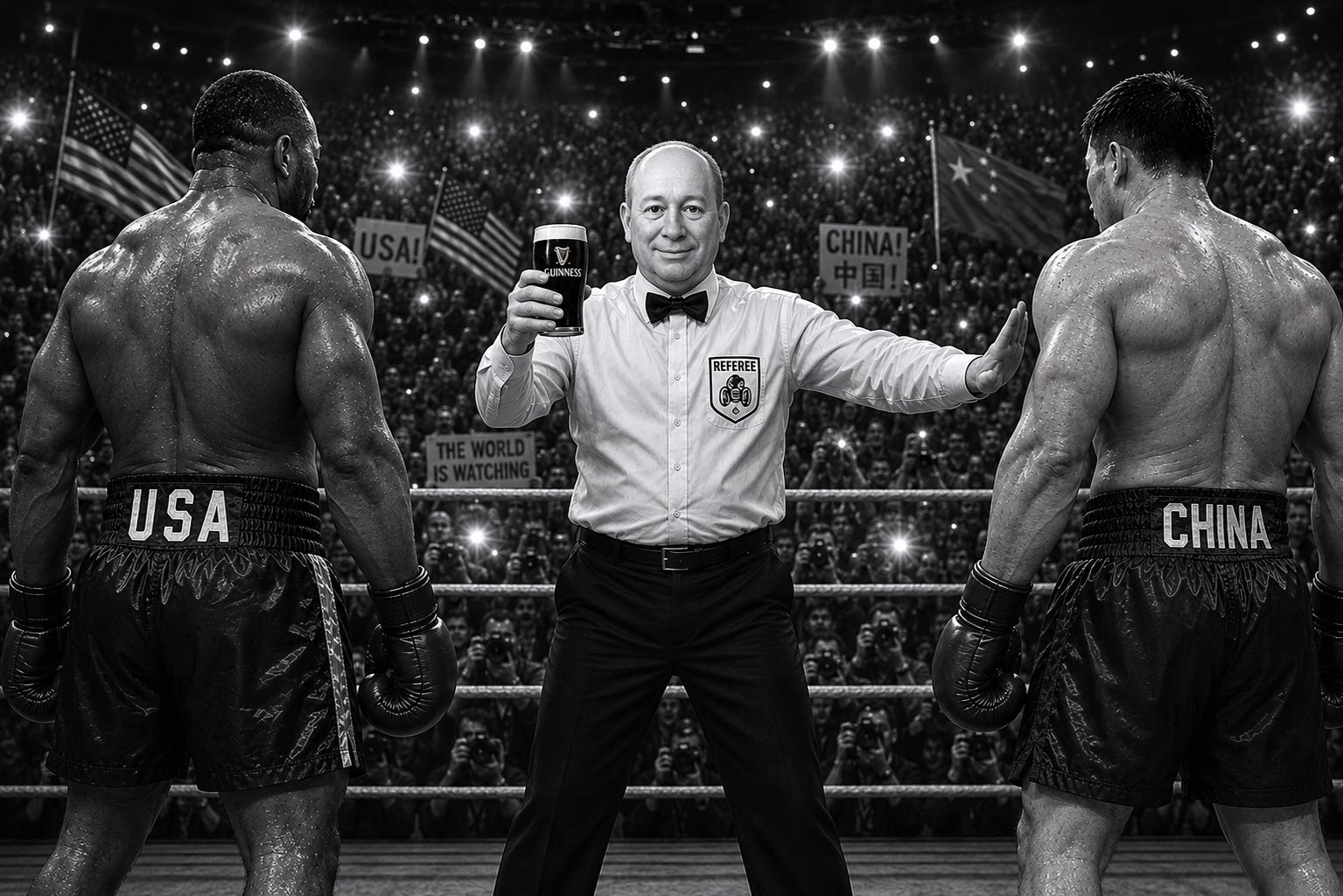
There are three regions of strategic interest to Washington: Europe, West Asia, and East Asia. The first and the second are in the ring with blows being traded, the third is in the locker room wrapping and strapping. During the election, there was hope that Trump would break the mold and throw in the towel on the first, not enter the ring on the second, and walk away on the third. Unfortunately, Trump’s a dodgy promoter with money on every fight.
As the second Trump administration finally turns to the Korean Peninsula, something uncomfortable is becoming obvious: U.S. policy hasn’t changed at all. South Korea is being prepped to join in the ring.
The rhetoric changes. The personalities change. The slogans change. But the strategic direction remains remarkably consistent. South Korea is still being repositioned inside a larger American confrontation with China. The peninsula is still viewed less as a unique political and historical problem than as a strategic node within a wider Indo-Pacific contest. North Korea remains frozen in managed hostility. And Seoul is still expected to carry more of the burden while aligning ever more tightly with Washington’s regional agenda. This continuity is becoming difficult to ignore.
Trump came into office promising disruption. Instead, he has largely inherited and continued the same structural foreign policy trajectory visible under Biden. Ukraine policy remains fundamentally unchanged: sustain the conflict, weaken Russia, maintain pressure, avoid direct American costs wherever possible. Iran policy also followed the same escalatory logic of coercion, containment, and strategic confrontation. If a Democrat had won, we’d be in the exact same position.
The implication is unsettling because it turns conspiracy into reality. Whichever party gets in, you have the foreign policy of John McCain. Cynicism is at an all time high. For many, the problem is no longer Russia, Iran, or China. It is America.
Call it the “deep state,” the national security establishment, the permanent bureaucracy, the foreign policy blob, or simply institutional inertia. The label matters less than the pattern. Presidents come and go, but the strategic machine continues moving in roughly the same direction. Cabinet members rotate. Think tanks recycle personnel. Generals retire into consultancy firms. Intelligence officials become television commentators. The deep rot state.
The assumptions from the Biden Admin have carried into the Trump Admin. China must be contained. Allies must be mobilized. Strategic pivots must continue.
Peripheral regions must be integrated into the larger contest. The Korean Peninsula is no different. It is contestable geopolitical terrain.
That is the real lesson emerging from the Trump administration’s approach to Korea. The peninsula is no longer primarily about reunification, reconciliation, denuclearization, or even stability. It is about positioning. Logistics. Strategic depth. Missile reach. Supply chains. Naval access. Regional balancing.
In short, Korea is being prepared as another frontline in a broader conflict.
Washington’s language now openly reflects this shift. American strategic documents increasingly frame South Korea not simply as a state requiring protection from North Korea, but as part of a larger regional architecture aimed at managing China. The alliance is evolving from a peninsula-focused defense arrangement into a component of Indo-Pacific strategy.
This should alarm South Koreans far more than another round of Trump theatrics.
Because history suggests what happens next for states caught inside great power confrontations is rarely pleasant. Ukraine became the battleground where strategic pressure against Russia could be applied. Iran became the arena through which Middle Eastern order is contested. Neither country enjoys stability. Neither controls escalation. Both exist inside larger geopolitical struggles driven by outside powers.
South Korea exists as a divided nation because it was the very first state to be contested in the post-war era. Now, it risks drifting toward the same condition: not abandoned by the United States, but absorbed into American strategic competition.
For years, South Korean conservatives warned of abandonment while progressives warned of entrapment. Increasingly, both are occurring simultaneously. Washington expects Seoul to shoulder more military responsibility while also demanding tighter integration into anti-China strategy. South Korea is being asked to become more autonomous operationally while becoming less autonomous strategically.
The future, quite frankly, does not look bright.
The space for genuinely Korean solutions is rapidly shrinking. Inter-Korean diplomacy has collapsed. Reunification discourse is fading into irrelevance. North and South now either openly or quietly consider permanent separation as the solution. Meanwhile, the United States and China view the peninsula less through the lens of Korean aspirations and more through the lens of regional competition.
This is how middle powers disappear into history: not through dramatic conquest, but through gradual strategic absorption into conflicts designed by others.
Trump was supposed to change everything. Instead, he’s just revealed that the machine underneath American foreign policy hasn’t slowed down. South Korea is being prepped to join in the ring and Trump will profit from the outcome—win or lose.
—
Help a punch-drunk boxer - Buy Me a Coffee!
The question is: What the ruling class of America is willing to sacrifice in order to confront China.
The US elites know that a full scale war with China will mean the total collapse of the world order thus the collapse of the West's economic and political position.
The oligarchs are unwilling to risk losing their position on a suicidal war.
The West's fundemental problem with China is that China refuse to open its market up to foreign ownership and is increasingly able to project economic power.
"Democracy","Human Rights" are but political propaganda to mobilize the masses to fight for their masters against China.
The only interest group I see willing to confront China is Peter Thiel aligned oligarchs,their project is to create a one world government to in their eyes preserve progress,that will mean the whole scale looting of every industrial powers,that includes China,Russia,Iran,India and so on.
Even then,a conventional war is inadvisable for the US for the US now lack the industrial capacity to actually win that conflict.Thus containment is vastly more realistic and is the US strategy to deal with China.
The West don't actually care about their vassals regardless of what they think,they will sacrifice them if the power dynamics is stacked against them as we could see in Czechoslovakia,Poland and so on.
Of course,China can do much to disrupt the US's strategy,the contest is far from won for the US.
Yes. The U.S. and Japan once again want to use Korea to attack China.
But the people of Korea will have their say, and they will be a mighty obstacle to overcome, just as they stood up against the coup and the bloody dictatorships.
https://substack.com/@aaronruby/note/p-188961420?r=7jhui4