

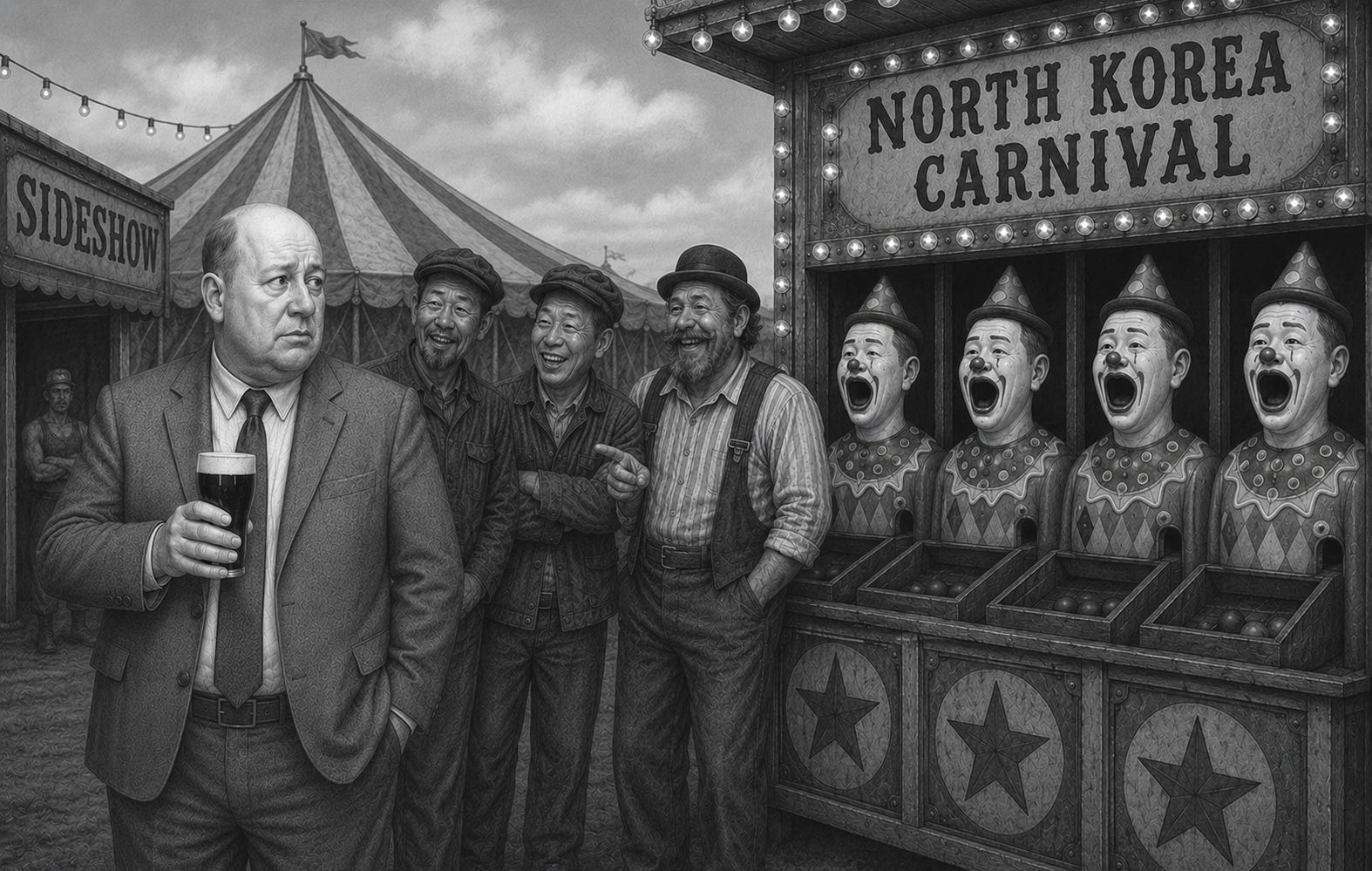
It was a strange suspended state—a carnival packed up for winter, with the tents folded, the trucks loaded, but the carnies still skulking round leering at people as they walked by. Then, with little warning Trump told the world that he and Xi talked about North Korea. With that brusque aside by a man who lies for a living, the stage is again lighting up the liminal—the North Korea carnival is back.
The think tank spruikers, sanctions specialists, defector whisperers, the intel gurus, missile trajectory enthusiasts, and the collapse prophets now sense a change in the air. The first tent is off the truck, the first carnie sweat has broken, the turning clowns are being oiled.
Somewhere in Washington, a Korea specialist has updated their conference proposal. Somewhere else, an NGO quietly dusted off a funding application on humanitarian engagement. Editors who have not commissioned a Korea piece in two years are answering emails again. Never hesitating, the ringmasters at Foreign Affairs anticipated this, and called forward the clowns. The North Korea carnival, dormant but never dead, is again stirring.
Why now? Because Trump’s interest in North Korea was never a diplomatic issue. It was never a desire to solve the enduring diplomatic conundrum. Trump did not try to end the stalemate because ending it would have required preparation, patience, and policy discipline — the very things he avoided. There were summits, photo opportunities, and theatrical gestures, but no serious diplomatic machinery behind them. The optics mattered more than outcomes. The spectacle mattered more than strategy. It was a farcical fumbling clown show from beginning to end, and it fueled an economic stimulus package for an entire class of analysts, commentators, consultants, and institutions.
The first Trump administration transformed Korea watching from a niche specialty into a global media spectacle. While North Korea watching had always been a pretty whack, weird, liminal space, Trump turned it into an industry.
Cable news panels multiplied. Endless explainers appeared. Every handshake, insult, missile test, and summit photograph generated another round of commentary. “Fire and Fury” became both foreign policy and content strategy. He brought us closer to war and absolute annihilation, but also, according to the live-to-air CNN panels, it was different and could indeed be everlasting peace.
For journos, it was a ball. There’s no other reporting space that joins together the risk of annihilation and the quirky and absurd, nor is there a better location for passionate screamed street interviews. And so it will be again.
The think-tankers, like carnies with with questionable pasts, have been pacing up and down their imaginary cell. Being thoroughly institutionalized they’ve already put out their fixed set of timed publications on such remarkably innovative ideas, such how Trump can engage Kim Jong-un or how re-labelling diplomatic efforts can transform the entire entrenched f$#k up. For journos, they’re an easy call, and will be ready to give their advice—in fact, most will have a think-tank press release already prepared for your use.
Then there’s the academics. They’re a surly lot: grumpy, arrogant, pompous and petulant. Like carnies who found a lost wallet, they’re both excited and nervously uncertain about unfolding events. During the break they’ve been writing ever-unfinished books and pointless academic papers nobody will ever read. For journos, if you can find one that doesn’t mumble or respond in endless equivocations, they’re also pretty easy.
Next are the fly-by-nighters. Like carnies on the run from the law, they’ve got something to hide but they’re loud enough and confident enough to hide it well. Every new North Korea carnival season will bring out a few. One season, it was the 1000 op-eds guy; another season, it was the interesting accent guy; and in yet another, it was the ‘I was in Pyongyang’ guy. The responses don’t vary, but for journos, these guys are worth their weight in buffalo dung… because that is after all, what they’re selling.
Then there’s the journos who because they once set foot in Pyongyang or reported on the country for more than a few months, end up becoming a member of the carnival themselves. They’ve got a book, they’ve got a cable news profile, and they urgently need attention. That’s the carnie equivalent of a kneaded newspaper, a rent-a-loo, and a bowel full of carnival hot-dogs. For journos, don’t call them, they’ll call you.
North Korea is one of the few geopolitical issues where permanent unresolved tension sustains an entire professional ecosystem. True normalization would put them out of business because their knowledge of Korea is in the end is distant and delusional. Total collapse would do the same. The ideal condition for the industry is endless semi-crisis: enough danger to justify conferences and commentary, but not enough to fundamentally alter the status quo.
Trump understands this dynamic better than most. He instinctively grasps that North Korea is not merely a security problem but political theater. His summits with Kim Jong-un were geopolitical reality television—dramatic, personalized, visual, and unpredictable. Every shocking Trump statement generated another policy panel, another television appearance, another op-ed, another urgent funding round.
For some carnies, it gets boring. There are rumors of competitions between them—who can say “salmon” and “hardworking” on CNN or Fox gets drinks bought all night, ending in statements like “Trump is a salmon swimming against the political stream in his hardworking pursuit of peace.” It livens up the rat-ass boredom of rehashing what’s been said a thousand times before. They’re the ones to watch.
This begs a question: aren’t the public not yet tired of the carnival? I mean, after Ukraine and Iraq, do we really need another war or near-war followed by promised but remote agreements? With the High Street empty and the economy four times more f%^#d than the last time the carnival was in town, you’d think not.
Then, in all truth, one last show before the carnival packs up for good and goes home forever, might just be fun. I just hope one carnie can take up the challenge and tell the world that the whole show is f%^#d and should’ve been solved years ago if it weren’t for the clowns in Washington.
—
I’d prefer to be a novelist. Help me pay for writing lessons - Buy Me a Coffee!
To trump, KJU is the modern version of Atilla the Hun