
Time for a grand diplomatic bargain?
It’s tempting to imagine that major powers will sit down and strike a grand bargain to reorder the world - but they won’t. At least, not in West and East Asia.

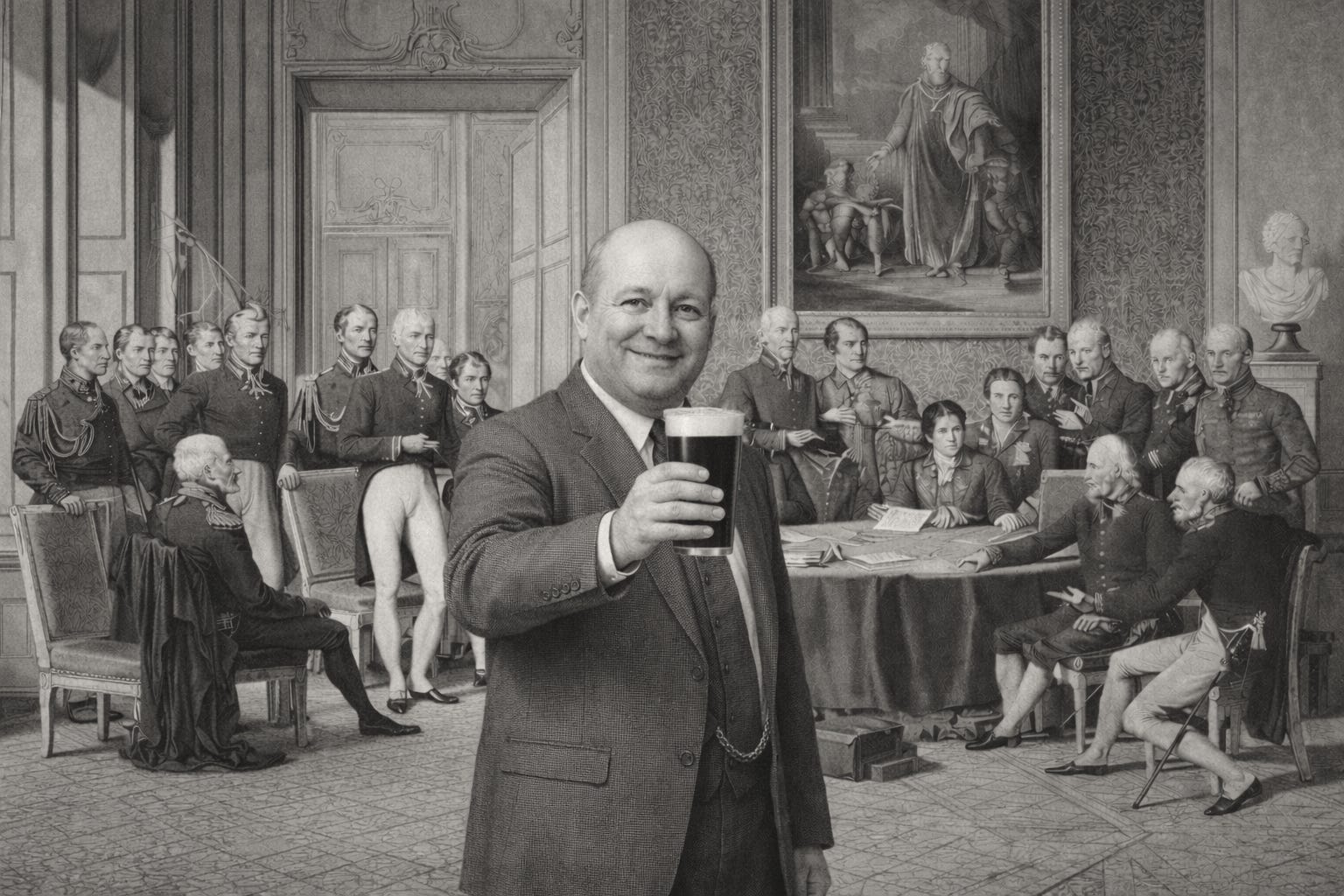
The Cold War did not end with a grand diplomatic bargain. There was no Peace of Westphalia, Congress of Vienna, Berlin Conference, or Potsdam Conference - moments when powers came together to reconcile legitimate interests and realities on the ground to secure lasting peace.
Instead, we essentially had a near forty-year frat party where the victors partook in drunken excesses and the losers bowed their heads and built their credentials.
The Iran conflict and its consequent (imminent) economic crisis has brought that frat party to a sudden end. It’s tempting to imagine that once again, the major powers will sit down and strike a grand diplomatic bargain to reorder the world.
First, there’s Europe. The war in Ukraine is drifting toward exhaustion. Russia cannot be defeated and Europe is tiring. Europe cannot sustain confrontation and now without access to Middle East oil and gas nor Russian energy, it is undermining its own economic base with every day the war continues. A settlement—however uneasy, is inevitable. Trade will resume in altered form. Energy flows will be reconfigured. Political language will soften. Europe will, in time, move from exclusion back to accommodation.
Then there’s West Asia, the logic appears similar. The confrontation with Iran has reached its structural limits. Iran holds all the cards and the U.S. and Israel have no choice but to concede - outside extremes that don’t bear contemplation. The United States will be forced to remove itself from the region, Iran will be acknowledged as a regional hegemon, and BRICS (read China) will provide the logistics.
Finally, there’s East Asia. The region reflects a contest between continental and maritime power—China’s proximity against America’s distant network of bases and alliances. For decades, U.S. dominance sustained this balance, but it is now shifting. China’s rise and advances in missiles, surveillance, and air defence are eroding the advantages of maritime projection, turning distance into a constraint. The result is a more precarious order: U.S. forces are increasingly exposed, allies more uncertain, and the region drifting toward a gradual reordering in which China’s centrality deepens and American advantages narrow.
It’s tempting to imagine that major powers will sit down and strike a grand bargain to reorder the world - but they won’t.
At least not in West and East Asia.
Grand diplomatic bargains are a European diplomatic tradition. We’re now in a different system and Chinese diplomatic traditions will soon come to the fore.
European diplomacy emerged from a fractured, competitive system of roughly equal states, and it carried the imprint of that history: balance-of-power thinking, formal congresses, legally codified settlements, and the expectation that rivals can be brought to the table and bound by mutually recognised agreements.
Chinese diplomatic tradition, by contrast, developed within a hierarchical order centred on a dominant civilisation-state, where stability derived less from negotiated equilibrium than from acknowledged primacy, managed asymmetry, and relational ties rather than fixed legal bargains.
Where the European model seeks closure through grand settlements and clearly delimited spheres, the Chinese approach has historically been more incremental, status-conscious, pragmatic and fluid—preferring calibrated adjustment, deference, and long-term positioning over definitive, one-off bargains.
So what can we expect to happen?
In Europe, we’ll maybe see the last grand diplomatic bargain. Russia’s settlement of the Ukraine conflict, will reconcile Europe’s legitimate interests with its own realities on the ground, and secure a lasting peace.
The United States and Europe are not in a position to argue. Their diplomacy (and strategic acumen) has been found wanting. Their relative power has declined, their domestic politics constraining strategic flexibility, and their alliances no longer instruments of unified design but arenas of divergence. Let’s face it, the United States top diplomats are a couple of real estate finance grifters with questionable loyalty to their homeland - and Europe’s best diplomats at the behest of their feckless leaders follow their lead. They cannot impose order, nor can they negotiate its replacement.
In West Asia, China will be reluctant to pursue a decisive, European-style settlement that fixes outcomes, redraws balances, and binds actors into a stable, final arrangement. Instead, it will prefer to call for ceasefires, facilitate dialogue, and position itself as a mediator while avoiding responsibility for enforcing any agreement.
The result will be a system in which a strengthened Iran does not anchor a negotiated regional order, but rather sits within a looser, more fluid hierarchy—one sustained by economic ties, tacit understandings, and shifting alignments. China’s priority is not to close the system through a grand bargain, but to keep it open, stable enough for trade, and flexible enough to preserve its relationships across competing actors, including Iran, the Gulf states, the U.S. and Israel.
In East Asia, the likely result is not a dramatic rupture but a steady unwinding. U.S. forces will thin out—first in function, then in presence—on the Korean Peninsula and, in time, even in Japan. Taiwan’s status will shift from a focal point of confrontation to a question managed within a broader regional accommodation, with integration—formal or otherwise—quietly accepted.
The South China Sea will cease to be contested in practice, becoming an acknowledged sphere of Chinese primacy. What were once flashpoints will be repurposed into channels of coordination, trade, and managed interdependence. The language will remain cautious, even ambiguous, but the substance will be clear: regional states prioritising economic continuity and systemic stability over abstract commitments and open-ended confrontation.
This is what the end of the post–Cold War era looks like. Not a grand settlement, not a new congress of powers, but the quiet end of the near forty-year “frat party” that followed U.S victory. There will be no moment of reckoning where victors and losers gather to formalise a new order. No declarations, no signatures, no clean lines drawn across maps. The expectation of such a moment is itself a relic of a European diplomatic imagination that no longer fits the system taking shape.
We’re in a new era. The United States will not declare retreat; Europe will not declare accommodation; East Asia will not declare hierarchy. But each, in its own way, will begin to act as if these conditions already hold. There will be no formal settlement—and no grand diplomatic bargains to settle relations among the major powers. There will be calibrated adjustments, quiet understandings, and a gradual alignment with the centre. Welcome to the era of Chinese statecraft.