
Trump in Beijing
For all the pathetic bravado handshakes and the rude confused rambling, Trump will be in Beijing as a supplicant seeking China’s help

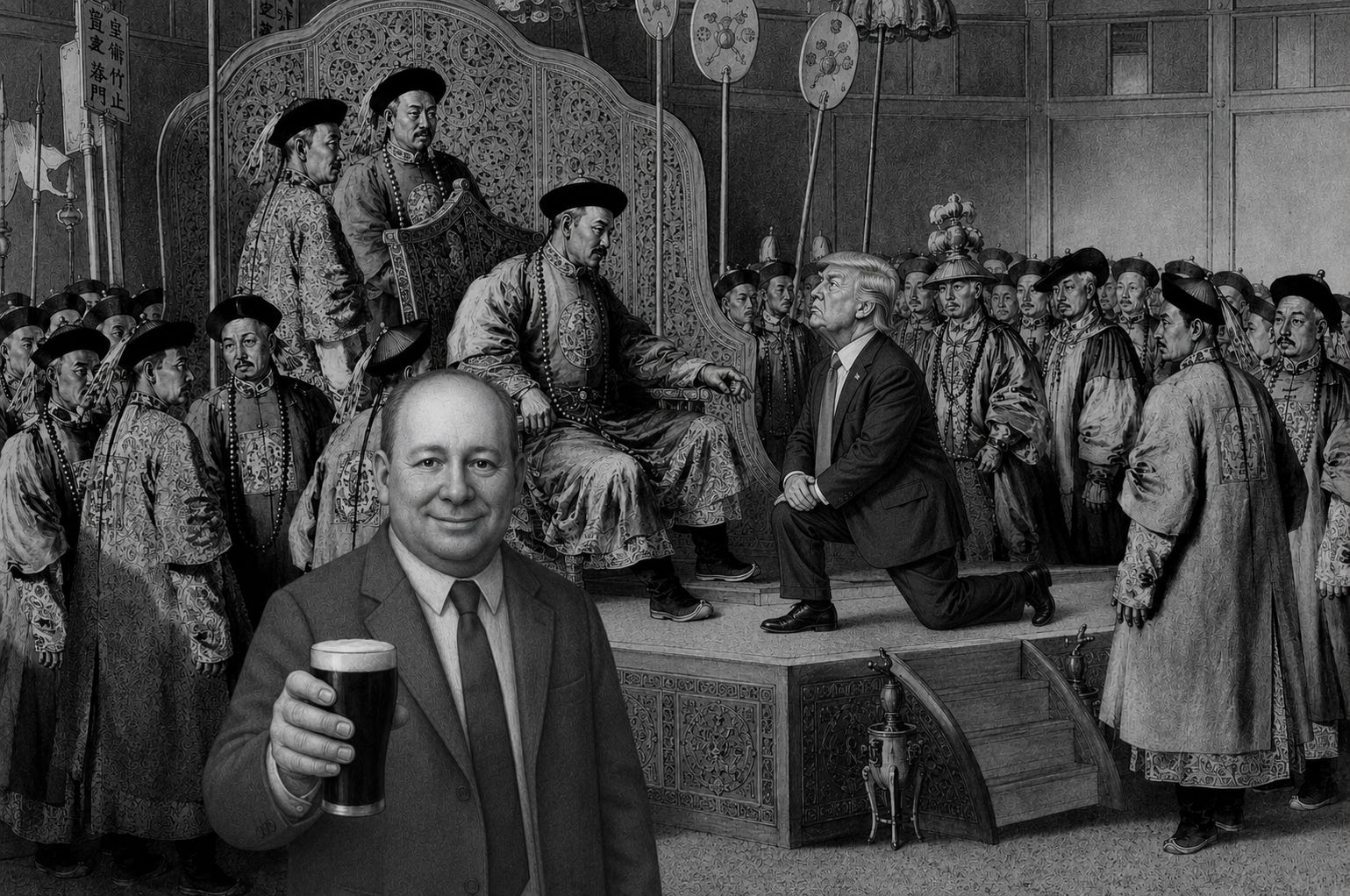
Some presidential moments record history succinctly: Ronald Reagan in Berlin declaring, “Mr. Gorbachev, tear down this wall” at the end of the Cold War; George W. Bush beneath the “Mission Accomplished” banner aboard the USS Abraham Lincoln and the strategic debacle of the War on Terror; and Barack Obama announcing America’s “pivot to Asia,” and U.S. concerns regarding an emergent China.
When Trump visits Beijing, we’ll have another such moment: The end of the American empire.
Trump will be himself. Awkward, confused but dozily confident, no sense of diplomatic protocol, but ready to sell real estate or seek graft to enrich himself and his family. He comes to Beijing with an abysmal economic record and a Seoul Sunday morning spew of confused tariff and trade deals.
For all the pathetic bravado handshakes and the rude confused rambling, he will be in Beijing as a supplicant seeking China’s help—a position no American president has previously occupied.
Trump comes to Beijing with each and every U.S. ally hedging or actively preparing for Washington’s departure. He comes as the instigator of conflicts in Ukraine (accepting that NATO expansion started the conflict) and Iran, both of which are now lost and awaiting settlement. He comes as an individual that has so lowered the U.S. presidency that he sells fragrances, commemorative coins, and has filled the oval office with bling.
Xi Jinping will be himself. Stoic, disciplined, reserved, and meticulously prepared. He arrives not as a political entertainer, but as the representative of a state that increasingly appears patient, organized, and historically conscious. Under Xi, China has expanded its industrial dominance, deepened its technological capacity, consolidated state authority, modernized its military, decreased and punished corruption, and steadily increased its diplomatic influence across the Global South.
Whatever one thinks of the Chinese system, Xi projects continuity and command. He stands at the apex of a centralized political structure that faces no serious domestic electoral challenge and increasingly behaves with the confidence of a power that has time moving in its favor.
The imagery will be powerful. A Trump visit to Beijing will be one of those rare civilizational moments that captures an era ending in real time.
The leader of the post-Cold War American order arriving in the capital of the rising Chinese century will symbolize more than negotiation. It will symbolize acknowledgment. Not formal surrender, nor immediate replacement, but the quiet recognition that the United States no longer stands above the system it once organized.
American corporate leaders will accompany Trump to Beijing. They want stabilization, access, accommodation, and relief from economic tensions. The symbolism will resonate globally in ways Washington clearly doesn’t fully appreciate.
Future historians will interpret the image alongside earlier symbolic turning points in imperial history: moments where older powers remained formidable but no longer appeared to direct history itself. The visit would visually invert the hierarchy that defined the late twentieth century.
For decades, leaders traveled to Washington seeking integration into an American world. A presidential visit to Beijing under current circumstances instead risks conveying the opposite — that access to stability, industrial capacity, markets, and perhaps even the future itself, increasingly flows through China.
China (or rather Trump) has turned everything around. China now projects the image of patience, continuity, discipline, industrial capacity, and civilizational confidence. It is as if China offers a new way —an alternative to the confusion, disorder, and instability that Trump’s America has imposed on the world. The United States today projects volatility, polarization, institutional distrust, financial fragility, and political exhaustion. It’s not the America we once knew.
The contrast is impossible to ignore internationally. International relations is not shaped by material power alone, but by imagery and perception. Images compress complex geopolitical shifts into instantly recognizable symbols that shape how populations, elites, and historians interpret the balance of power. In many cases, the image becomes more enduring than the policy itself.
Recall the famous depiction of George Macartney at the court of the Qianlong Emperor during the Macartney Embassy of 1793. A subtle depiction showing the refusal of a British envoy to kowtow to the emperor, marking the declining power of the imperial throne and its passage from the center to the periphery. Trump’s visit will act as a bookend. China is once again at the center of the world.
The images of Trump in Beijing will hit headlines across the world and will stun those in Australia, Canada, Europe, South Korea, Japan and the Philippines.
For years, U.S. allies have comforted themselves with the belief that Trump is merely an aberration — a temporary detour from an otherwise stable American trajectory. They’ve clung to the assumption that “the adults” would eventually return, that institutions would self-correct, and that the deeper foundations of American primacy remained intact. Imagery has a brutal clarifying power.
Watching an erratic American president arrive in Beijing seeking accommodation from a confident and disciplined Chinese leadership will force many allies to confront a far more unsettling possibility: Trump is not the exception, but a symptom of deeper American exhaustion, fragmentation, and decline.
Future historians will look back on Trump’s visit to Beijing not simply as another summit, but as a civilizational image: the leader of the post-Cold War order arriving in the rising imperial capital at the precise moment the balance tipped decisively eastward. The imagery itself may come to symbolize the point where much of the world quietly concluded that the future no longer belongs to Washington.
—
Support, share, comment, and/or subscribe - Buy Me a Coffee!
Okay. Brutal.
But calling reality - reality.