
Watch out middle powers, the tide is coming in!
For decades, the US-led system functioned much like that sandcastle but now the tide is coming in.

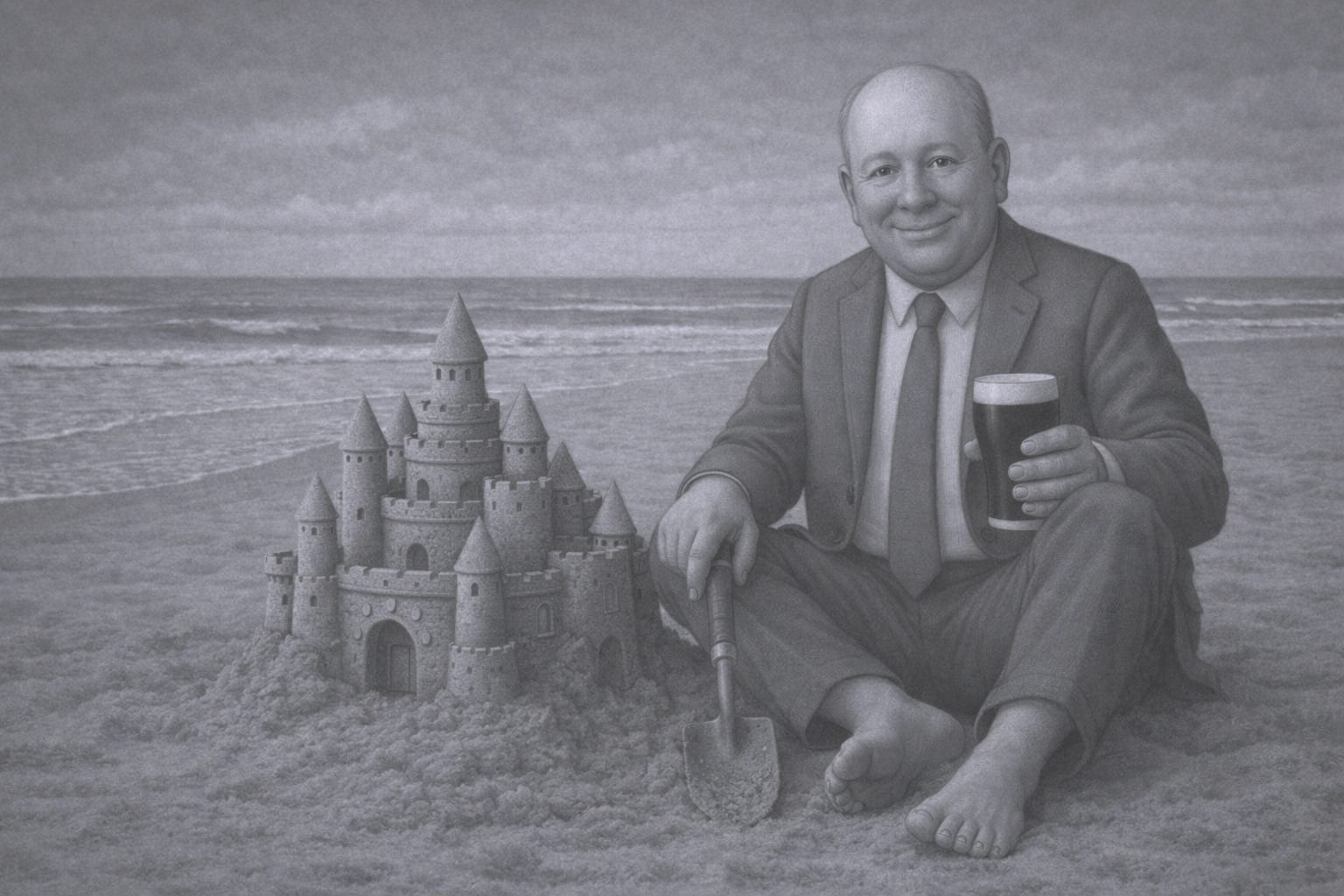
I’m not a big fan of the beach. It reminds me of the never-ending fight between Scottish genetics and the Australian sun. I lost every fight and came home redder than a well-boiled lobster, but like most Australian kids, I still loved the beach - especially sandcastles. There’s no greater joy I have in building this analogy for middle powers and their choices as the tide of change begins to sweep over the sandcastle they helped build.
One of the best things about sandcastles was that others join in. No one built a grand sandcastle alone. Some shaped towers, others carved out defensive walls, others ferried water in cupped hands to bind the structure together. Over time, it became something impressive: layered, interconnected, surprisingly resilient. It had form, function, and—most importantly—a shared belief that it would hold.
This is also how international order is made.
For decades, the U.S.-led system functioned much like that sandcastle. Institutions were shaped, norms embedded, alliances layered like reinforced walls. Trade routes flowed like carefully carved channels. There were flaws—structural weaknesses, uneven foundations—but the collective effort sustained it. More importantly, most participants believed in maintaining it.
But then the tide comes in.
Not suddenly. Not dramatically. But undeniably.
The water creeps forward, first filling the outer trenches, then softening the base of the walls. The edges begin to blur. The new wing built onto the sandcastle by that gawky uncoordinated boisterous orange-haired buffoon weakens the sandcastle walls.
What once looked permanent now looks temporary. The assumption that the castle would stand indefinitely begins to dissolve.
And so the question emerges—not theoretical, but immediate. What do you do when the tide comes in?
Pick up a shovel?
One option is to walk away from the castle entirely and join the group further down the beach—the ones already digging in a different direction.
They are not trying to preserve what was built. They are building something new.
This is the path of integration into an emerging order—one that is not anchored in Washington, but elsewhere. The tools look different. The design is less familiar. The rules are still being negotiated, sometimes imposed. But there is energy there. Momentum. Direction.
To pick up a shovel is to accept that the tide is not an aberration—it is the defining condition.
It means becoming a founding participant in what comes next, rather than a nostalgic defender of what is receding. It requires adjustment: diplomatic, economic, and strategic. It requires learning new norms, engaging new centres of power, and—crucially—accepting that influence now comes from proximity to the builders of the new structure, not loyalty to the old one.
There is risk here. The new castle may not be stable. The builders may not share your interests. You may end up contributing to something that ultimately marginalises you.
But there is also opportunity: to shape the design early, to embed your preferences before the structure hardens.
Walk to the other end of the beach?
A second option is more solitary. You leave both groups—the defenders of the old castle and the builders of the new—and walk down the beach until you find your own stretch of sand. There, you begin again. Smaller, perhaps. More compact. But entirely yours.
This is the logic of independent security.
In practical terms, it means reducing reliance on external guarantees and building capabilities that ensure survival regardless of the fate of larger systems. Historically, this has often meant one thing above all others: nuclear weapons.
A nuclear capability is the ultimate sandcastle reinforcement—not because it stops the tide, but because it deters others from interfering with your space on the beach. It is a declaration: whatever happens to the broader order, this patch of sand is not up for negotiation.
This path offers clarity. Autonomy. A kind of brutal certainty.
But it comes at a cost. It is isolating. When some kid’s mum comes along and offers everyone an ice-cream, you’re not there to receive it. It invites pressure, sanctions, and suspicion. It reduces room for diplomatic manoeuvre. And it does not solve the larger problem—it simply sidesteps it.
You are not saving the castle. You are not shaping the new one. You are building a bunker in the sand and hoping it holds.
Try to hold back the tide?
The third option is the most familiar—and, perhaps, the most instinctive.
You stay where you are. You rally the others. You reinforce the walls. You dig channels to redirect the water. You pile sandbags. You tell yourselves that with enough effort, enough coordination, enough belief, the castle can still be saved.
This is the project of restoring or sustaining the U.S.-led liberal international order.
It is not irrational. The castle is, after all, impressive. It delivered decades of relative stability and prosperity. Its institutions still function. Its alliances still exist. Its defenders are still numerous and, in many cases, powerful.
Though in the end, the problem is not a lack of effort. It is not even a lack of resources. The problem is the tide and it ain’t stopping.
Structural shifts—economic, technological, geopolitical—are moving the water in ways that no amount of shovelling can fully reverse. Power has diffused. The balance between continental and maritime forces has shifted. The assumptions that underpinned the original design no longer hold in the same way.
Trying to hold back the sea risks exhausting energy on a fundamentally losing proposition. Worse, it can blind participants to alternative strategies—locking them into a defensive posture as the environment transforms around them.
This is not to say the effort is meaningless. Parts of the castle may be preserved. Elements may be carried over into whatever comes next.
But the idea that the structure can be fully maintained as it was—that you can repair what that gawky uncoordinated boisterous orange-haired buffoon wrecked, or that the tide can be pushed back indefinitely—is increasingly difficult to sustain.
Make a choice - now!
You’re now sunburnt, and there’s probably just an hour or two until your skin will be so painful to the touch that you’ll regret ever having gone to the beach. What do you do?
The reality, of course, is that most states will not choose just one path. They will hedge. They will hedge awkwardly, inconsistently, sometimes incoherently.
They will pick up a shovel with one hand, reinforce the old walls with the other, and quietly begin sketching out their own small castle further down the beach.
But hedging is not a strategy. It is a delay. At some point, choices harden. Resources are finite. Commitments become visible. Others begin to respond. And so the question returns, sharper each time the water advances.
Do you help build what comes next? Do you secure yourself against it? Or do you try, against the tide, to preserve what is slipping away? There is no perfect answer. Only trade-offs. But one thing is clear. The incoming tide is not going to slow down.
Support, share, comment, and/or subscribe - Buy Me a Coffee!
In Soviet Russia, we never saw the USA as a sandcastle. Our government inspired fear of the USA in us, children, and adults. It was our main enemy. How easily can a sandcastle be destroyed, which is so fearful to the others, especially the Soviet country with which all the others were in full delight or full fear? Nobody understood, not even we, that the Soviet Union would be destroyed in 72 years of its existence. America still stays, and still people from other countries come here as emigres, as my family was. The country has a lot of serious, emigration among them, problems, two partis which became enemeis, instead of working together for the good of the country, and so on... But not a sandcastle.