Research proposals set out the research you intend to undertake and provides a clear account of how you expect the project to develop. They’re real important.
First, a research proposal explains what you want to research, why the research is worth doing, and how you intend to conduct it. It demonstrates that you have identified a worthwhile and researchable question, have begun to understand the relevant academic literature, and have a realistic plan for answering that question.
Second, a research proposal occupies an important place in the research process. It comes after you have identified an area of interest, undertaken preliminary reading, and begun developing your research question, but before you conduct the main research. This means it brings these early decisions together and helps identify problems with the question, evidence, concepts, or methods before substantial research begins. It’s essentially a working plan rather than a contract, since the project may change as the research develops.
Third, and most important, it secures a check-point in the eyes of those that support your research. It can be used to secure support to continue research for students, and/or it can be used to secure support from a funding source. Either way, it’s at this point where your research either progresses, or requires rethinking and reworking.
Why research proposals?
Clarify your research — what you want to know and why it matters.
Test your idea — determine whether the question is researchable and realistic.
Plan the research — decide what evidence, theory, and methods you will need.
Identify problems early — before investing substantial time in the research.
Communicate your project — show others what you intend to do and why.
Secure approval — acquire academic approval or research funding.
Most research proposals follow a similar structure. They introduce the research problem and question, explain how the project relates to the existing literature, establish its theoretical or conceptual approach, and describe the research design and methods that will be used. They may also address evidence, ethics, limitations, and the practical requirements of completing the research.
The seven basic questions approach
There are many guidebooks and online resources for preparing a research proposal. The best resource for young academics is Denscombe’s Seven Basic Questions Approach.
Denscombe, Martyn. Research Proposals: A Practical Guide. 3rd ed. Maidenhead: Open University Press, 2025 (https://www.mheducation.co.uk/research-proposals-a-practical-guide-3rd-edition-9780335253562-emea-group)
Rather than beginning with a fixed proposal template, Denscombe argues that a researcher should first be able to answer seven basic questions about the proposed research:
What is it all about? (Topic, research problem and question)
What do we already know about the subject? (Literature)
What does the research need to find out? (Measurement)
How will we get the necessary information? (Method)
What will it cost and how long will it take? (Planning)
Is the research socially acceptable? (Ethics)
What are the benefits? (Potential significance)
These questions address the purpose of the research, its relationship to existing knowledge, the research question, the methods to be used, the resources required, ethical considerations, and the expected outcomes. Together, they require you to think through the main decisions that must be made before a research project can begin.
The value of this approach is its simplicity. If you cannot provide a clear answer to one of the questions, there is probably an aspect of the research that still needs further thought. Working through the seven questions therefore provides a useful bridge between developing a research idea and writing the formal proposal.
I strongly encourage you to go to the university library and borrow a copy of Denscombe’s Research Proposals: A Practical Guide, or, if possible, buy your own copy. It is a short, accessible, and practical guide that you can return to whenever you need to develop a research project or write a proposal. The skills it teaches are not limited to this course: they will be useful throughout your academic life, from undergraduate papers to postgraduate research, theses, publications, and research grant applications.
The guided academic paper - research proposals
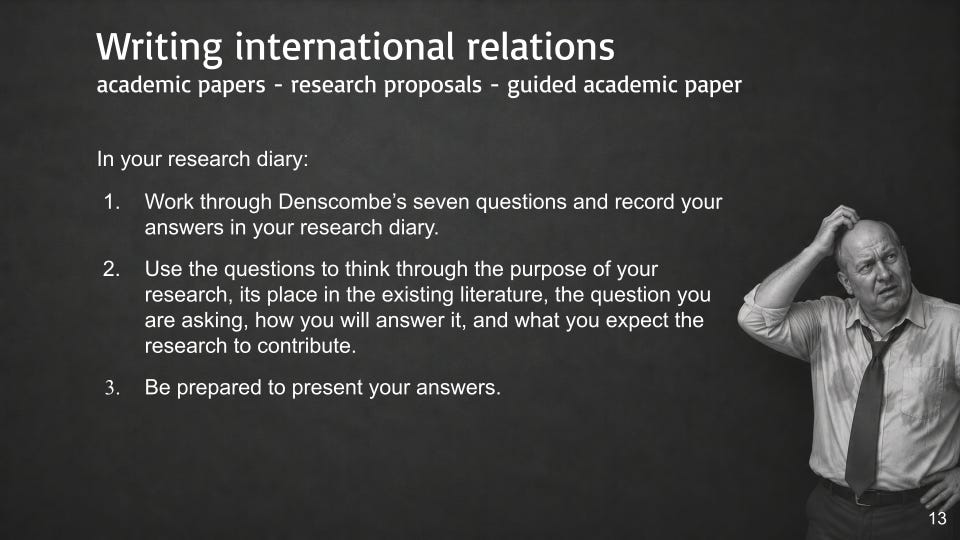
For your guided academic paper, work through Denscombe’s seven questions and record your answers in your research diary. Do not treat this simply as an exercise for writing the proposal. Use the questions to think through the purpose of your research, its place in the existing literature, the question you are asking, how you will answer it, and what you expect the research to contribute.
Return to these answers throughout the research process. As you read more, refine your question, encounter problems, or reconsider your methods, update your research diary to reflect how the project is changing. Your answers should gradually become clearer and more convincing.
You should also be ready to present these answers whenever someone asks about your research—whether that is your professor, a classmate, another academic, or someone outside your field. Being able to explain what you are researching, why it matters, what others have already said, and how you intend to answer your question is an important academic skill. Denscombe’s seven questions provide a simple framework for doing this throughout the life of your research project.